

The invitation lands in your inbox: networking mixer, holiday party, team happy hour. Your stomach tightens. For years, a drink or two helped smooth the edges of workplace social events, making small talk feel easier and anxiety more manageable. But relying on alcohol to get through these gatherings comes with its own complications, and you're ready for a different approach.
Social anxiety at work events is incredibly common, even among high-performing professionals. The pressure to appear confident, make the right impression, and connect with colleagues can trigger physical symptoms like racing thoughts, sweaty palms, and that overwhelming urge to escape. When alcohol has been your go-to coping mechanism, facing these situations sober can feel daunting.
The good news: you can learn to navigate work events with genuine confidence, without relying on drinks to get you through. The strategies that follow offer practical, science-backed alternatives that address the root of social anxiety rather than just masking it temporarily.
Quick Take
- Social anxiety at work events often stems from fear of judgment and uncertainty about how to behave, not a personal failing
- Preparation strategies like setting time limits and identifying conversation partners can reduce anticipatory anxiety by up to 40%
- Physical grounding techniques activate your parasympathetic nervous system, counteracting the fight-or-flight response
- Having a non-alcoholic drink in hand serves multiple purposes: it gives you something to do and signals you're participating socially
- Post-event reflection helps rewire anxious thought patterns and builds confidence for future gatherings
Why Social Anxiety Intensifies at Work Events
Work-related social gatherings create a unique pressure cooker of anxiety triggers. Unlike casual social situations where you can simply avoid people or leave early without consequence, professional events carry the weight of your career, reputation, and daily work relationships. Research suggests that this combination of social evaluation and professional stakes activates our threat-detection systems more intensely than purely social or purely professional situations alone.
Your brain interprets these events as high-risk scenarios where mistakes could have lasting consequences. The amygdala, your brain's alarm system, goes into overdrive, triggering the release of stress hormones like cortisol and adrenaline. This creates those familiar physical symptoms: rapid heartbeat, shallow breathing, mental fog, and an overwhelming desire to escape or numb the discomfort.
When alcohol has been your usual strategy, your brain has learned to associate work events with drinking. This creates a double challenge: you're not only managing the anxiety itself but also breaking a conditioned response pattern. Understanding this neurological connection helps explain why the urge to drink can feel so strong in these specific situations, even when you're committed to not drinking.
Daily Support for Social Drinkers
Your liver works hard every day. Give it consistent support.
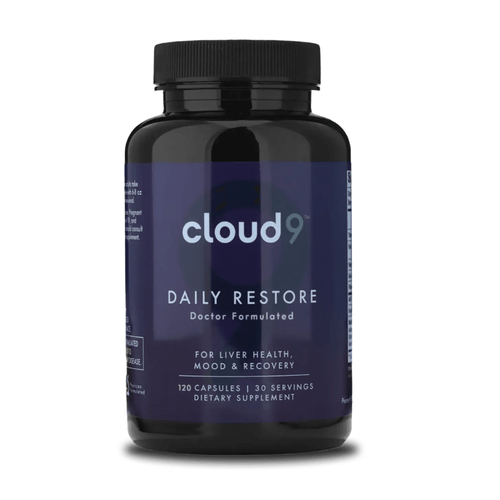
Cloud9 Daily Restore combines NAC, DHM, milk thistle, B vitamins, and ashwagandha to help support the pathways alcohol can tax most. Two capsules daily, drinking or not.
NAC | DHM | Milk Thistle | B Vitamins | Ashwagandha
See How Daily Restore WorksPreparation Strategies That Actually Work
The most effective way to manage social anxiety at work events starts hours or even days before you walk through the door. Preparation reduces uncertainty, one of anxiety's primary fuel sources, and gives you a concrete action plan when your nervous system starts firing distress signals.
Set Your Event Parameters
Before the event, decide on specific boundaries that will help you feel in control. Studies show that having predetermined limits significantly reduces decision fatigue and anxiety during stressful situations. Write these down if it helps make them feel more concrete.
- Determine your arrival and departure times (arriving 15 minutes after start time can mean fewer awkward early moments)
- Identify a minimum meaningful interaction goal (like having three substantial conversations instead of working the entire room)
- Plan your exit strategy, including a specific reason to leave that feels authentic
- Choose what you'll drink instead of alcohol, and visualize yourself holding it
- Decide on a trusted colleague or friend you can check in with during the event
Research and Reconnect
If you know who's attending, spend a few minutes reviewing LinkedIn profiles or recent company updates. This isn't about stalking, it's about reducing the cognitive load of small talk. When you already know someone recently returned from maternity leave or led a successful project, you have ready-made conversation starters that feel genuine.
For larger events where you won't know everyone, prepare three or four go-to questions that invite substantive responses. Questions about current projects, industry trends, or even how someone ended up in their role tend to generate more engaging conversations than weather commentary.
Practice Your Physical Response
In the days before the event, practice a simple grounding technique you can use discreetly during the gathering. The 5-4-3-2-1 method works well: identify five things you can see, four you can touch, three you can hear, two you can smell, and one you can taste. This sensory inventory interrupts anxious thought spirals and brings you back to the present moment.

In-the-Moment Techniques for Managing Anxiety
Even with thorough preparation, anxiety can spike once you're actually at the event. These real-time strategies help you stay grounded without reaching for a drink to take the edge off.
The Power of Purposeful Breathing
Your breath is the fastest way to signal safety to your nervous system. When anxiety kicks in, your breathing becomes shallow and rapid, which actually increases feelings of panic. Box breathing, a technique used by everyone from Navy SEALs to corporate executives, can restore calm within minutes.
Breathe in for four counts, hold for four, exhale for four, hold for four. Repeat this cycle three to five times. The beauty of this technique is that you can do it while appearing to simply pause and listen in a conversation. Research suggests that controlled breathing activates the vagus nerve, which directly counteracts your stress response.
Strategic Positioning and Movement
Where you position yourself in a room significantly impacts your comfort level. Avoid staying in the center of crowded spaces, which can feel overwhelming. Instead, position yourself near the edges or in conversation clusters of three to four people, which tend to be more manageable than larger groups.
Give yourself permission to move. Walking to refresh your non-alcoholic drink, stepping outside briefly for air, or excusing yourself to the restroom aren't signs of weakness. They're strategic resets that prevent anxiety from building to unmanageable levels.
The Replacement Ritual
If holding a drink was part of your coping strategy, maintain that physical ritual with an intentional non-alcoholic alternative. The act of holding something and occasionally sipping serves multiple psychological functions: it occupies your hands, gives you something to do during conversation lulls, and signals to others that you're participating in the social aspects of the gathering.
The physical act of holding a glass and bringing it to your lips can be soothing even without alcohol. Your brain responds to the familiar ritual, and a well-crafted non-alcoholic option lets you participate in toasts and social drinking customs without compromising your commitment to staying clear-headed.
Conversation Frameworks That Reduce Pressure
Social anxiety often stems from uncertainty about what to say or fear of awkward silences. Having a mental framework removes some of that pressure. The FORD method (Family, Occupation, Recreation, Dreams) provides a simple structure for steering conversations into meaningful territory without veering into inappropriate topics.
Remember that being interested is more valuable than being interesting. When you focus on asking thoughtful follow-up questions rather than performing or impressing, conversations flow more naturally and you feel less self-conscious about your own contributions.
Managing the Urge to Drink
Even with excellent coping strategies, you may experience strong urges to drink at work events, especially if alcohol has been your primary anxiety management tool. Understanding and preparing for these urges helps you move through them without acting on them.
Recognize the Urge Cycle
Urges follow a predictable pattern: they rise, peak, and naturally decline, typically within 15 to 20 minutes. This is crucial information because our anxious brain tells us the discomfort will intensify indefinitely unless we make it stop. Studies show that urges are time-limited, and each one you successfully ride out weakens the neural pathway connecting anxiety to drinking.
When an urge hits, acknowledge it without judgment. "I'm noticing the urge to have a drink right now" is very different from "I need a drink" or "I can't handle this." The first statement creates observer distance; the latter two create urgency and distress.
The Urge Surfing Technique
Imagine the urge as a wave. You don't try to stop waves, you ride them. Notice where you feel the urge in your body (tightness in chest, tension in shoulders, restlessness in your limbs). Breathe into those sensations rather than fighting them. Rate the intensity on a scale of 1 to 10, and continue checking in every few minutes. You'll notice it peaks and then gradually decreases.
During this process, keep your body moving. Excuse yourself to walk to a different part of the venue, engage someone new in conversation, or step outside briefly. Physical movement helps process the nervous energy without acting on the urge.
Your Emergency Response Plan
Before attending any event, have a concrete plan for moments when staying feels truly overwhelming. This might include a trusted person you can text, a specific place you can go to reset (your car, a nearby coffee shop, a quiet outdoor area), or a decision point at which you'll simply leave early without guilt.
| Warning Sign | Immediate Action | Follow-Up Strategy |
|---|---|---|
| Physical symptoms intensifying (rapid heart rate, difficulty breathing) | Find a quiet space, practice box breathing for 2 minutes | Splash cold water on face and wrists, then reassess if you can return |
| Strong, persistent urge to drink that isn't passing | Text your support person, get your non-alcoholic drink refreshed | Give yourself 10 more minutes, then permission to leave without guilt |
| Feeling disconnected, like you're watching from outside yourself | Use 5-4-3-2-1 grounding technique, focus on physical sensations | Move to the edge of the space, find one person for genuine conversation |
| Overwhelmed by crowd size or noise level | Step outside or to a quieter area immediately | Stay in lower-stimulation zones, join smaller conversation groups only |
Building Long-Term Confidence
Managing social anxiety at work events without alcohol gets easier with practice, but only if you approach each experience as a learning opportunity rather than a test you either pass or fail.
Post-Event Reflection
Within 24 hours of each event, spend 10 minutes writing down what went well, what felt challenging, and what you learned. Your anxious brain will want to fixate on awkward moments or perceived failures. Deliberately documenting successes, no matter how small, helps rewire those negative thought patterns.
Note specific moments when you successfully managed anxiety or urges. "I felt a strong urge to drink at 7:15 PM, used the breathing technique, and it passed within 10 minutes" becomes evidence that you can handle these situations. This evidence accumulates over time, building genuine confidence.
Gradual Exposure
You don't have to commit to attending every work event immediately. Research on anxiety treatment consistently shows that gradual exposure is more effective and sustainable than forcing yourself into overwhelming situations. Start with shorter, lower-stakes events and build up to the bigger, more challenging ones.
Create a personal hierarchy of work social situations from least to most anxiety-provoking. A lunch with your immediate team might rank lower than a company-wide evening networking event. Work through this hierarchy intentionally, allowing yourself to build skills and confidence at each level.
Developing Alternative Coping Skills
The techniques in this article are starting points, but managing social anxiety long-term means building a comprehensive toolkit of coping strategies. Consider working with a therapist who specializes in anxiety, particularly someone trained in cognitive behavioral therapy or acceptance and commitment therapy, both of which have strong evidence for treating social anxiety.
- Regular mindfulness or meditation practice strengthens your ability to observe thoughts and sensations without reacting
- Physical exercise, particularly cardiovascular activity, reduces baseline anxiety levels and improves stress resilience
- Sleep consistency directly impacts anxiety levels and your capacity to manage social stress
- Social skills practice in lower-stakes environments builds competence and reduces uncertainty
- Connection with others who understand the challenge of managing anxiety without alcohol provides validation and practical support
Redefining Success
Traditional networking advice suggests you should work the room, make dozens of connections, and leave energized. For someone managing social anxiety, that's an unrealistic and unnecessarily stressful standard. Success might look like staying for your predetermined time, having one meaningful conversation, or simply attending without drinking.
Your professional relationships and career won't suffer because you don't stay until the end of every event or connect with every person in the room. They will benefit from you showing up authentically, engaging genuinely with the people you do talk to, and taking care of your mental health in the process.
How Daily Restore Supports Your Health
Understanding what your body needs is one thing. Getting consistent daily support is another. Daily Restore was designed to address the key pathways alcohol can stress most, in one simple daily formula.
NAC (N-Acetyl Cysteine)
Supports glutathione production and antioxidant defenses
DHM (Dihydromyricetin)
Supports alcohol metabolism
Milk Thistle (Silymarin)
Supports healthy liver function
B Vitamins
Help replenish nutrients involved in energy and metabolism
Ashwagandha
Supports stress resilience and healthy cortisol balance
Daily Restore is not a detox or a cure. It is a daily support formula designed for people who drink socially and want to give their body consistent, evidence-informed support.
Frequently Asked Questions
How can I explain not drinking at work events without making it awkward?
Keep it simple and confident. You can say "I'm not drinking tonight" or "I'm sticking with sparkling water." Most people won't press further, and those who do are revealing more about their own relationship with alcohol than anything about your choice.
What if everyone else is drinking and I feel left out?
Remember that connection doesn't come from what's in your glass. Focus on meaningful conversations and genuine interactions rather than matching what others are drinking. Many people actually appreciate having someone present who's fully engaged and can remember the conversations the next day.
Can supplements really help with social anxiety?
Research suggests that certain ingredients like ashwagandha, L-theanine, and GABA may support the body's stress response and promote a sense of calm. While supplements aren't a cure for anxiety, they can be part of a broader approach that includes behavioral strategies, healthy sleep habits, and stress management techniques.
How long before an event should I take Daily Restore?
Daily Restore works best as part of a consistent daily routine rather than as a one-time solution before events. Taking it regularly helps build foundational support for your nervous system over time, which can make navigating social situations feel more manageable naturally.
What if my social anxiety is severe?
If social anxiety significantly impacts your daily life or work performance, consider speaking with a mental health professional. Therapy approaches like cognitive behavioral therapy have strong evidence for treating social anxiety, and a therapist can provide personalized strategies that go beyond what general wellness tools can offer.
The Bottom Line
Managing social anxiety at work events without alcohol isn't about white-knuckling your way through discomfort. It's about building sustainable strategies that support both your nervous system and your professional relationships. From grounding techniques and strategic positioning to thoughtful supplement support, you have more tools than you might realize.
The key is consistency. Daily practices like proper sleep, stress management, and foundational nutritional support create resilience that makes those occasional networking events feel less overwhelming. When your baseline stress levels are better managed, the peaks become easier to navigate.
This is where Daily Restore fits in. Rather than reaching for something in the moment of anxiety, building daily support with ingredients like ashwagandha, GABA, and L-theanine can help your body maintain a calmer baseline. Combined with the behavioral strategies we've covered, this kind of consistent support may make those work happy hours feel less like a threat and more like just another part of your week.
You don't need alcohol to be interesting, connected, or professionally successful. You just need tools that actually work for you, and the confidence to show up as yourself.
Build Your Daily Support Routine
Build Your Daily Support Routine
If drinking is part of your lifestyle, your support routine should not be random. Daily Restore was designed to help social drinkers support liver health, antioxidant defenses, alcohol metabolism, nutrient replenishment, and daily recovery in one simple routine.
NAC
DHM
Milk Thistle
B Vitamins
Ashwagandha