

You finish a stressful day, but hours later your shoulders are still tight, your jaw is clenched, and sleep feels impossible. That lingering tension isn't just in your head. Your body has its own memory system for stress, and it doesn't let go as quickly as your mind does.
This matters because chronic tension changes how your nervous system responds to everyday challenges. When stress becomes embedded in your tissues and nervous pathways, even small frustrations can trigger outsized physical reactions.
Understanding why your body holds onto stress, and learning techniques that actually help release it, can shift you from constant tension to genuine recovery. Here's what the science reveals.
Quick Take
- Your nervous system can remain in stress mode for hours or days after the initial trigger ends, creating lasting physical tension
- Stress hormones like cortisol take time to metabolize, extending the body's stress response well beyond the mental experience
- Muscle memory patterns can trap tension in specific areas, creating chronic tightness that feels automatic
- Breath-based and body-centered techniques work faster than cognitive approaches because they directly influence the nervous system
- Progressive relaxation practices help retrain your body to recognize and release tension patterns before they become chronic
How Your Nervous System Stores Stress Beyond the Moment
Your sympathetic nervous system activates instantly when stress hits, flooding your body with cortisol and adrenaline. But deactivation works on a much slower timeline. Research suggests it can take 20 to 60 minutes for stress hormones to clear your bloodstream, and your nervous system may remain hypervigilant for hours afterward.
This creates a gap between feeling mentally calm and being physically relaxed. You might logically know a stressful meeting is over, but your body is still braced for threat. Over time, this gap widens as your baseline tension level creeps upward.
Studies show that repeated stress exposure can alter your autonomic nervous system's default setting, making it harder to access true relaxation. Your body essentially forgets what "off" feels like, keeping you in a state of perpetual readiness that exhausts your systems.
Daily Support for Social Drinkers
Your liver works hard every day. Give it consistent support.
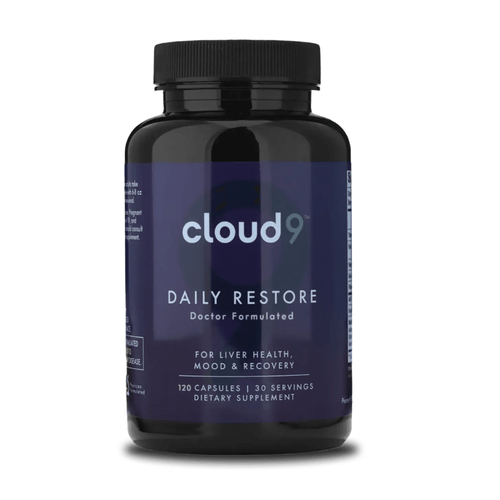
Cloud9 Daily Restore combines NAC, DHM, milk thistle, B vitamins, and ashwagandha to help support the pathways alcohol can tax most. Two capsules daily, drinking or not.
NAC | DHM | Milk Thistle | B Vitamins | Ashwagandha
See How Daily Restore WorksThe Physical Architecture of Stored Tension
Stress doesn't just float through your body and disappear. It embeds itself in specific physical structures, creating patterns that persist long after the original stressor fades.
Muscle Memory and Chronic Contraction
Your muscles develop holding patterns in response to repeated stress. Common areas include the trapezius muscles across your shoulders, the jaw muscles from clenching, and the hip flexors from prolonged sitting in tense postures. These patterns become so automatic that you stop noticing them.
The fascia, the connective tissue surrounding your muscles, can also stiffen and adhere when held in stressed positions. This creates a mechanical restriction that reinforces tension even when you consciously try to relax.
Hormonal Aftereffects
Cortisol has a half-life of 60 to 90 minutes, meaning it takes several hours for levels to drop significantly after a stress response. During this window, your body remains in a state of heightened alertness. Inflammation markers can stay elevated even longer, contributing to that heavy, achy feeling that lingers after intense stress.
Chronic stress can also dysregulate your cortisol rhythm, leading to elevated evening levels that interfere with sleep and prevent overnight recovery. This creates a cycle where insufficient rest makes you more vulnerable to next-day stress.
Neural Pathway Sensitization
Your brain strengthens the neural circuits that get used most frequently. When stress responses fire repeatedly, those pathways become more sensitive and easier to trigger. This phenomenon, called neural sensitization, means smaller stressors can activate the same intense physical response over time.
The good news is that neural pathways are plastic. Relaxation practices can build competing pathways that make calm responses more accessible with consistent use.
Why Traditional Relaxation Advice Often Falls Short
The most common relaxation advice focuses on the mind, but your body needs direct, physical intervention to release deeply held tension patterns.
Being told to "just relax" or "stop worrying" doesn't address the physical component of stress storage. Your conscious mind can't directly command your autonomic nervous system to stand down or tell your fascia to release.
Many relaxation approaches also work too slowly for the modern pace of stress accumulation. If you're adding tension faster than your recovery practices can clear it, you'll steadily move toward chronic stress states despite your best intentions.
The Mind-Body Communication Gap
Cognitive techniques like positive thinking or distraction can help shift your mental state, but they often leave physical tension untouched. You might feel mentally calmer while your heart rate remains elevated and your muscles stay contracted.
Effective relaxation requires bottom-up approaches that speak directly to your body's stress systems. These techniques bypass cognitive processing and work through physical inputs that your nervous system recognizes as safety signals.
Relaxation Techniques That Address How Your Body Actually Holds Stress
The most effective relaxation methods work with your body's stress storage mechanisms rather than against them. These approaches target the specific ways tension embeds itself in your physical systems.

Progressive Muscle Relaxation
This technique works by systematically tensing and releasing muscle groups, teaching your body to recognize the difference between contraction and release. Research suggests it can lower cortisol levels and reduce both subjective and physiological markers of stress.
The practice is particularly effective because it addresses muscle memory patterns directly. By deliberately creating and releasing tension, you're retraining the neural pathways that control muscle tone.
- Start with your feet and move upward through each major muscle group
- Tense each area for 5 to 7 seconds, then release completely for 20 to 30 seconds
- Notice the sensation of release, training your awareness to recognize relaxation
- Practice for 15 to 20 minutes when tension is high, or 5 to 10 minutes as daily maintenance
Diaphragmatic Breathing
Deep belly breathing activates your vagus nerve, the major pathway of your parasympathetic nervous system. This creates a direct physiological shift away from stress response, often within just a few breath cycles.
Unlike shallow chest breathing, which can actually maintain stress states, diaphragmatic breathing sends clear safety signals to your brain. Studies show it can reduce heart rate, lower blood pressure, and decrease cortisol levels measurably.
- Place one hand on your chest and one on your belly
- Breathe in slowly through your nose, expanding your belly while keeping your chest relatively still
- Exhale slowly through your mouth, letting your belly fall naturally
- Aim for a 4-count inhale and 6-count exhale to activate the relaxation response
- Practice for 5 to 10 minutes, or use brief 2-minute sessions throughout your day
Body Scan Meditation
This mindfulness technique builds awareness of where you're holding tension and helps release it through focused attention. Research suggests that regular body scanning can reduce the intensity of stored stress and prevent new tension from accumulating unnoticed.
The practice works by bringing conscious awareness to areas that typically operate on autopilot. When you notice tension without judgment, your nervous system often releases it spontaneously.
- Lie down or sit comfortably and close your eyes
- Slowly move your attention through your body from toes to head
- Notice areas of tightness, warmth, coolness, or numbness without trying to change them
- Breathe into tense areas, imagining the breath softening and releasing the tension
- Spend 10 to 20 minutes for a full scan, or focus on problem areas for quicker sessions
Self-Massage and Myofascial Release
Direct physical manipulation of tense muscles and fascia can release holding patterns that breathing and awareness alone can't reach. Studies show that even brief self-massage can reduce muscle tension and lower stress hormone levels.
Focus on common tension storage sites where stress tends to accumulate and persist. Use firm but gentle pressure, working slowly to allow tissues time to respond.
| Tension Zone | Self-Massage Technique | Duration |
|---|---|---|
| Shoulders and neck | Use opposite hand to knead trapezius muscle from neck to shoulder | 2-3 minutes per side |
| Jaw | Circular massage on masseter muscle in front of ears | 1-2 minutes |
| Lower back | Tennis ball against wall, rolling slowly over tight spots | 3-5 minutes |
| Feet | Roll foot over tennis ball or massage arch with thumbs | 2-3 minutes per foot |
Restorative Yoga Poses
Unlike active yoga styles, restorative poses use props to support your body in positions that encourage passive release. This approach allows your nervous system to shift into rest mode while gravity and time work on chronically tight areas.
The extended hold times, typically 5 to 15 minutes per pose, give your fascia time to release and your nervous system time to recalibrate. Research suggests restorative yoga can significantly reduce cortisol and improve heart rate variability, a marker of nervous system flexibility.
- Supported child's pose with bolster under torso releases back and shoulder tension
- Legs-up-the-wall pose encourages lymphatic drainage and nervous system calming
- Supported reclined bound angle opens the chest and hip flexors while triggering relaxation
- Use blankets, bolsters, or pillows to ensure you're completely supported and comfortable
Building a Personalized Stress Release Practice
The most effective relaxation routine matches your specific stress patterns and fits realistically into your daily life. A perfect technique you never use won't help as much as a simple one you practice consistently.
Identifying Your Stress Storage Patterns
Pay attention to where tension shows up in your body first and lingers longest. Some people clench their jaw, others tighten their shoulders, and some hold stress primarily in their gut or chest. Your pattern points to which techniques will work best.
Notice also when tension accumulates most. Morning stress may respond better to energizing breathwork, while evening tension often needs slower, more sedative approaches like body scanning or restorative poses.
Timing and Frequency That Actually Works
Brief, frequent practice often outperforms longer, occasional sessions for stress that accumulates daily. Three 5-minute breathing breaks throughout your day can prevent tension buildup more effectively than a single 20-minute session at day's end.
Layer techniques for different purposes. Use quick breathing or muscle release during acute stress moments, body scans for daily maintenance, and longer restorative practices weekly for deeper nervous system recovery.
| Stress Pattern | Best Technique | Optimal Timing |
|---|---|---|
| Acute, situational stress | Diaphragmatic breathing | 2-3 minutes immediately during or after stress |
| Daily accumulation | Body scan meditation | 10 minutes before bed |
| Chronic muscle tension | Progressive muscle relaxation | 15 minutes, 3-4 times weekly |
| Physical holding patterns | Self-massage or myofascial release | 5-10 minutes daily on problem areas |
| Deep nervous system dysregulation | Restorative yoga | 30-45 minutes weekly |
Measuring What Actually Changes
Track physical markers rather than just how you feel mentally. Notice changes in sleep quality, jaw tension upon waking, shoulder tightness by midday, or how quickly you recover after stressful events. These concrete signs tell you whether your practice is reaching the stored tension level.
Give techniques at least two to three weeks of consistent use before evaluating effectiveness. Your nervous system needs time to learn new patterns, and some benefits accumulate gradually rather than appearing immediately.
How Daily Restore Supports Your Health
Understanding what your body needs is one thing. Getting consistent daily support is another. Daily Restore was designed to address the key pathways alcohol can stress most, in one simple daily formula.
NAC (N-Acetyl Cysteine)
Supports glutathione production and antioxidant defenses
DHM (Dihydromyricetin)
Supports alcohol metabolism
Milk Thistle (Silymarin)
Supports healthy liver function
B Vitamins
Help replenish nutrients involved in energy and metabolism
Ashwagandha
Supports stress resilience and healthy cortisol balance
Daily Restore is not a detox or a cure. It is a daily support formula designed for people who drink socially and want to give their body consistent, evidence-informed support.
Frequently Asked Questions
How long does it take for the body to fully release stored stress?
The timeline varies significantly depending on how long stress has been accumulating and which relaxation techniques you practice. Some people notice shifts within days of consistent practice, while deeper patterns may take weeks or months to unwind as your nervous system recalibrates.
Can stress really cause physical pain even after the stressful situation ends?
Yes, research suggests that chronic stress can lead to persistent muscle tension, headaches, and other physical discomfort that lingers well after the initial trigger has passed. Your body may continue holding tension patterns as a protective response until it receives clear signals that it's safe to relax.
Which relaxation technique works fastest for stress relief?
Breathwork and progressive muscle relaxation tend to produce the most immediate calming effects, often within minutes. However, the "best" technique is the one you'll practice consistently, since regular use creates the most meaningful long-term changes in how your body processes and releases stress.
Is it normal to feel emotional when practicing deep relaxation?
Absolutely. As your body releases stored tension, it's common to experience unexpected emotions or even tears. This is often a sign that your nervous system is finally processing stress that's been held for a long time, and it's generally considered a healthy part of the release process.
Do I need to practice relaxation techniques every day to see benefits?
Consistency matters more than perfection. Studies show that regular practice, even just 10-15 minutes several times per week, can help retrain your nervous system and reduce accumulated stress. Daily practice tends to produce more noticeable results, but any consistent routine is valuable.
The Bottom Line
Your body doesn't just "get over" stress the moment a challenging situation ends. Tension accumulates in your muscles, your nervous system stays on high alert, and stress hormones can linger far longer than most people realize. Understanding this reality is the first step toward actually addressing stored stress rather than just managing today's pressures.
The good news is that targeted relaxation techniques, from breathwork to progressive muscle relaxation to mindful movement, can help your body finally release what it's been holding. These practices work because they send clear physiological signals that it's safe to let go, helping to recalibrate your stress response over time.
Building a consistent routine is what creates lasting change. Cloud9's Daily Restore is designed to support this journey with adaptogenic herbs and calming botanicals that work alongside your relaxation practices. It's not about perfection or eliminating stress entirely, but rather giving your body the daily support it needs to process, release, and recover.
Whether you start with five minutes of deep breathing or a full evening wind-down ritual, taking intentional steps to help your body release accumulated tension can make a meaningful difference in how you feel, both physically and mentally.
Build Your Daily Support Routine
Build Your Daily Support Routine
If drinking is part of your lifestyle, your support routine should not be random. Daily Restore was designed to help social drinkers support liver health, antioxidant defenses, alcohol metabolism, nutrient replenishment, and daily recovery in one simple routine.
NAC
DHM
Milk Thistle
B Vitamins
Ashwagandha