

You've done it before: walked into a crowded room, felt your chest tighten, and reached for a drink to take the edge off. Maybe it's become a pattern, a reliable way to feel less awkward at parties, networking events, or even casual dinners with friends. The first drink loosens your shoulders. The second makes conversation flow. But somewhere around drink three or four, things start to blur, and the next morning, you're replaying everything you said with a sense of dread.
This isn't about judging your choices. It's about understanding what's actually happening in your brain and body when you use alcohol to manage social anxiety. Because while drinking might feel like a solution in the moment, research suggests it can actually make anxiety worse over time, creating a cycle that's harder to break the longer it continues.
If you're tired of relying on alcohol to feel comfortable around people, or if you've noticed that drinking is starting to cause more problems than it solves, this guide is for you. Let's look at why alcohol fails as an anxiety solution and what actually works instead.
Quick Take
- Alcohol temporarily reduces anxiety by affecting GABA receptors, but this relief lasts only 1-2 hours and is followed by a rebound effect that can make anxiety worse
- Regular drinking to manage social situations can lead to tolerance, meaning you need more alcohol to achieve the same calming effect
- The "hangxiety" you feel the day after drinking is a real neurological phenomenon caused by alcohol's impact on stress hormones and neurotransmitters
- Cognitive behavioral techniques, gradual exposure, and mindfulness practices show stronger long-term results for social anxiety than alcohol ever could
- Building genuine social confidence takes time and practice, but unlike drinking, it actually gets easier the more you do it
The Neuroscience Behind Why Alcohol Feels Like It Helps
When you drink alcohol, it affects multiple neurotransmitter systems in your brain simultaneously. The most significant impact is on GABA (gamma-aminobutyric acid), your brain's primary inhibitory neurotransmitter. Alcohol enhances GABA activity, which slows down neural firing and creates that familiar feeling of relaxation and reduced self-consciousness.
At the same time, alcohol suppresses glutamate, an excitatory neurotransmitter that keeps you alert and responsive to your environment. This combination creates a temporary buffer against the racing thoughts and physical tension that characterize social anxiety. Your internal critic quiets down. The fear of being judged feels less urgent. For a brief window, social interactions genuinely feel easier.
But here's what makes this relief so problematic: your brain is constantly working to maintain balance. When you repeatedly introduce alcohol to calm anxiety, your nervous system adapts by producing less GABA naturally and becoming more sensitive to glutamate. This means that when you're not drinking, your baseline anxiety level can actually increase, creating a physiological need for alcohol just to feel "normal" in social situations.
Daily Support for Social Drinkers
Your liver works hard every day. Give it consistent support.
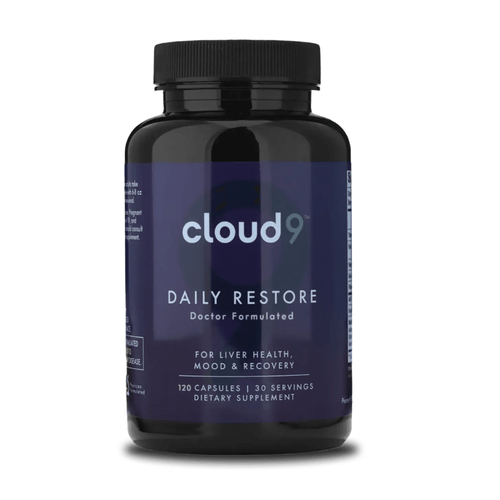
Cloud9 Daily Restore combines NAC, DHM, milk thistle, B vitamins, and ashwagandha to help support the pathways alcohol can tax most. Two capsules daily, drinking or not.
NAC | DHM | Milk Thistle | B Vitamins | Ashwagandha
See How Daily Restore WorksThe Rebound Effect: Why Tomorrow Always Feels Worse
The anxiety relief from drinking is both temporary and followed by a predictable backlash. As alcohol leaves your system, usually 4-8 hours after your last drink, your brain experiences a rebound effect. The same neurotransmitter systems that were suppressed now swing in the opposite direction.
GABA activity drops below baseline, while glutamate and stress hormones like cortisol surge. This creates what many people call "hangxiety," a state of heightened nervousness, rumination, and physical tension that can last 24-48 hours after drinking. Studies show this rebound anxiety is often more intense than the original social anxiety you were trying to escape.
What Happens in Your Body During Alcohol Withdrawal
Even if you're not physically dependent on alcohol, your body goes through a mild withdrawal process after drinking. This includes increased heart rate, disrupted sleep architecture, elevated cortisol levels, and decreased serotonin production. All of these changes contribute to feeling more anxious, not less, in the days following social drinking.
Your sleep quality takes a particular hit. While alcohol might help you fall asleep faster, it significantly reduces REM sleep, the restorative stage crucial for emotional regulation. Poor sleep directly worsens anxiety symptoms, creating another layer of the cycle.
The Memory and Confidence Problem
Here's another issue that rarely gets discussed: when you use alcohol to get through social situations, you don't actually build genuine social skills or confidence. Your brain doesn't encode the experience as "I successfully navigated that conversation" but rather "I needed alcohol to navigate that conversation." This reinforces the belief that you can't handle social situations sober, which strengthens anxiety rather than reducing it.
The irony of using alcohol for social anxiety is that it prevents you from discovering your own capability. Every drink whispers that you're not enough on your own, when the truth is that you've never given yourself the chance to find out what you're actually capable of.
How the Drinking-Anxiety Cycle Escalates Over Time
What often starts as an occasional social lubricant can gradually become a requirement. The progression is subtle but follows a predictable pattern that research has documented across thousands of cases.
Stage One: Occasional Relief
At first, you drink at parties or social events and notice it helps you feel more relaxed. The effects are pleasant, and you don't experience significant negative consequences. You might have one or two drinks and feel like a more outgoing version of yourself.
Stage Two: Increased Reliance
Over time, you start anticipating social events with the assumption that you'll drink. The thought of attending a party or dinner sober feels uncomfortable or even impossible. You might start drinking before events to "pre-game" your anxiety, or you feel noticeably more anxious at events where alcohol isn't available.
Stage Three: Tolerance and Escalation
Your body adapts to regular alcohol use, requiring more drinks to achieve the same anxiety-reducing effect. What used to be one or two drinks becomes three or four. You might notice that you're drinking more than others around you, or that you're often one of the last to leave because you're still drinking.
Stage Four: Negative Consequences
The downsides start accumulating. You say things you regret, experience frequent hangxiety, notice impacts on your work or relationships, or find yourself in situations you wouldn't have chosen sober. Your baseline anxiety increases, and you feel more nervous in general, not just in social situations.

What Actually Works: Evidence-Based Approaches to Social Anxiety
The good news is that social anxiety is one of the most treatable mental health conditions. Multiple approaches have strong research support, and unlike alcohol, they actually get easier and more effective with practice.
Cognitive Behavioral Therapy (CBT) Techniques
CBT for social anxiety focuses on identifying and challenging the thought patterns that fuel anxious feelings. The core principle is that it's not social situations themselves that create anxiety, but your interpretation of those situations and your predictions about how others will respond to you.
Common CBT strategies include:
- Identifying cognitive distortions like mind-reading ("Everyone thinks I'm boring") or catastrophizing ("If I say something awkward, it will be a disaster")
- Testing anxious predictions through behavioral experiments to gather real-world evidence
- Developing more balanced, realistic thoughts about social interactions
- Learning to distinguish between feelings and facts
Gradual Exposure: Building Confidence Through Practice
Exposure therapy involves systematically facing feared social situations in a gradual, controlled way. Unlike jumping into the deep end (which often backfires), this approach helps your nervous system learn that social situations are manageable and that anxiety naturally decreases when you stay in uncomfortable situations rather than escaping them.
You might start with lower-stakes interactions like making small talk with a cashier, then progress to attending a small gathering with close friends, and eventually work up to more challenging situations like giving presentations or attending networking events. The key is staying in each situation long enough for your anxiety to peak and then naturally decline, which teaches your brain that the situation is safe.
Mindfulness and Acceptance-Based Approaches
Rather than trying to eliminate anxiety completely, mindfulness-based strategies teach you to change your relationship with anxious feelings. Research suggests that resistance to anxiety often makes it worse, while acceptance can paradoxically reduce its intensity and duration.
Practical mindfulness techniques include:
- Grounding exercises that bring your attention to present-moment sensory experience rather than anxious thoughts
- Observing anxiety sensations with curiosity rather than judgment
- Practicing self-compassion when social interactions don't go as planned
- Using breathing techniques to activate the parasympathetic nervous system
Practical Strategies for Your Next Social Event
If you're used to drinking in social situations, the idea of showing up sober might feel overwhelming. Here are specific strategies that can help you navigate social events without alcohol while actually building genuine confidence.
Before the Event: Preparation Matters
Set yourself up for success by planning ahead. Eat a balanced meal beforehand so you're not hungry and irritable. Arrive slightly early when possible, as walking into a room of strangers already deep in conversation is harder than being there as others arrive. Have a few conversation topics or questions in mind, not as a script but as a safety net if your mind goes blank.
Decide in advance how you'll handle drink offers. Having a prepared response ("I'm taking a break from drinking" or simply "I'll have a soda, thanks") prevents you from making an impulsive decision in the moment.
During the Event: Staying Present
Instead of monitoring yourself constantly ("Am I being awkward? Do they think I'm boring?"), practice shifting your attention outward. Focus genuinely on what others are saying rather than rehearsing your next comment. Ask follow-up questions. Notice details about your environment. This reduces self-consciousness and paradoxically makes you more engaging.
When anxiety spikes, use it as a signal to ground yourself rather than a sign that something is wrong. Feel your feet on the floor. Take a slightly longer exhale than inhale. Remember that feeling nervous doesn't mean you're doing anything wrong, it just means you care about the interaction.
Comparison: Alcohol vs. Sustainable Strategies
| Aspect | Using Alcohol | Sustainable Approaches |
|---|---|---|
| Time to Effect | 15-30 minutes | Gradual, builds over weeks |
| Duration of Relief | 1-2 hours, followed by rebound | Lasting, improves with practice |
| Next-Day Impact | Increased anxiety, poor sleep, regret | Increased confidence, skill building |
| Long-Term Effect | Worsens anxiety, creates dependence | Reduces anxiety, builds resilience |
| Skill Development | Prevents learning, reinforces belief you can't cope | Develops genuine social competence |
| Health Impact | Physical health risks, sleep disruption | Improves overall well-being |
After the Event: Processing and Learning
How you reflect on social interactions matters as much as the interactions themselves. If you have social anxiety, you likely have a bias toward remembering awkward moments and dismissing positive ones. Deliberately counteract this by identifying at least three things that went well, even small things like remembering someone's name or having one good conversation.
Resist the urge to replay every detail looking for mistakes. This rumination strengthens anxiety pathways in your brain. Instead, ask yourself what you learned and what you might try differently next time, then deliberately shift your attention to something else.
Building a Support System That Actually Helps
Social anxiety can feel isolating, but you don't have to figure this out alone. The right support can make a significant difference in your progress.
When to Consider Professional Help
If social anxiety is significantly impacting your life, such as avoiding important events, limiting career opportunities, or leading to concerning drinking patterns, working with a therapist who specializes in anxiety disorders can be transformative. Therapy provides structured support, accountability, and personalized strategies that generic advice can't match.
Look for therapists trained in CBT or acceptance and commitment therapy (ACT), both of which have strong evidence for treating social anxiety. Many therapists now offer telehealth options, which can feel less intimidating if you're anxious about in-person appointments.
Creating Sober-Friendly Social Connections
Having friends who support your choice not to drink makes a huge difference. This doesn't mean everyone in your life needs to be sober, but having at least a few people who don't center activities around alcohol reduces pressure and provides models for enjoyable sober socializing.
Consider joining groups or activities where alcohol isn't the focus, like fitness classes, volunteer organizations, book clubs, or hobby-based meetups. These environments often make it easier to connect with others around shared interests rather than shared drinking.
Redefining What "Fun" Means
If most of your social life has revolved around drinking, you might need to actively explore what you actually enjoy about social connection. Is it the deep conversations? The laughter? The sense of belonging? Once you identify what you're really seeking, you can find ways to create those experiences without alcohol.
This might mean suggesting different types of activities to friends, like hiking, cooking together, going to museums, or attending live music. You might be surprised by how many people welcome alternatives to the standard bar meetup.
How Daily Restore Supports Your Health
Understanding what your body needs is one thing. Getting consistent daily support is another. Daily Restore was designed to address the key pathways alcohol can stress most, in one simple daily formula.
NAC (N-Acetyl Cysteine)
Supports glutathione production and antioxidant defenses
DHM (Dihydromyricetin)
Supports alcohol metabolism
Milk Thistle (Silymarin)
Supports healthy liver function
B Vitamins
Help replenish nutrients involved in energy and metabolism
Ashwagandha
Supports stress resilience and healthy cortisol balance
Daily Restore is not a detox or a cure. It is a daily support formula designed for people who drink socially and want to give their body consistent, evidence-informed support.
Frequently Asked Questions
Can one drink really help with social anxiety?
While many people report feeling more relaxed after one drink, the effect is temporary and doesn't address the underlying anxiety patterns. Research suggests that even moderate drinking can disrupt your body's natural stress response systems over time, potentially making anxiety worse in the long run.
How long does it take for natural anxiety supplements to work?
Most people notice subtle improvements within 2-4 weeks of consistent use, though some report benefits sooner. Unlike alcohol's immediate but short-lived effects, natural ingredients like L-theanine and ashwagandha work by supporting your body's stress response systems over time, leading to more sustainable results.
What's the best way to handle social situations without drinking?
Having a non-alcoholic drink in hand can help you feel more comfortable, and combining this with grounding techniques like deep breathing can make a real difference. Many people find that preparing ahead with calming supplements, arriving early to acclimate, and giving themselves permission to leave when needed helps them navigate social settings with greater ease.
Is social anxiety the same as shyness?
While they can overlap, social anxiety typically involves more intense worry about being judged or embarrassed, often accompanied by physical symptoms like racing heart or sweating. Shyness is usually milder and doesn't necessarily interfere with daily functioning, whereas social anxiety can significantly impact your quality of life and relationships.
Can you completely eliminate social anxiety?
Most experts focus on managing anxiety rather than eliminating it entirely, since some nervousness in social situations is completely normal. With the right combination of strategies, including behavioral techniques, lifestyle changes, and supportive supplements, many people find their anxiety becomes much more manageable and no longer limits their life.
The Bottom Line
While alcohol might seem like a quick fix for social anxiety, it's ultimately a Band-Aid that can make things worse over time. The temporary confidence boost comes with a cost: disrupted sleep, increased baseline anxiety, and the risk of developing unhealthy coping patterns that keep you stuck in a cycle.
Real, lasting relief comes from addressing anxiety at its root through consistent daily practices. This means supporting your nervous system with research-backed ingredients, building genuine coping skills, and giving your body what it needs to regulate stress naturally. The path might take longer than downing a drink, but the results are sustainable and actually improve your overall wellbeing.
Cloud9's Daily Restore offers a science-based approach to this kind of consistent support. With ingredients like L-theanine, ashwagandha, and magnesium glycinate, it's designed to help your body manage stress more effectively over time, not just mask symptoms in the moment. When combined with other healthy habits like adequate sleep, regular movement, and gradual exposure to social situations, it can be a valuable part of your daily routine.
You deserve to feel comfortable in social settings without relying on alcohol to get there. By investing in strategies that actually work with your body's natural systems, you can build genuine confidence that lasts well beyond the party.
Build Your Daily Support Routine
Build Your Daily Support Routine
If drinking is part of your lifestyle, your support routine should not be random. Daily Restore was designed to help social drinkers support liver health, antioxidant defenses, alcohol metabolism, nutrient replenishment, and daily recovery in one simple routine.
NAC
DHM
Milk Thistle
B Vitamins
Ashwagandha