
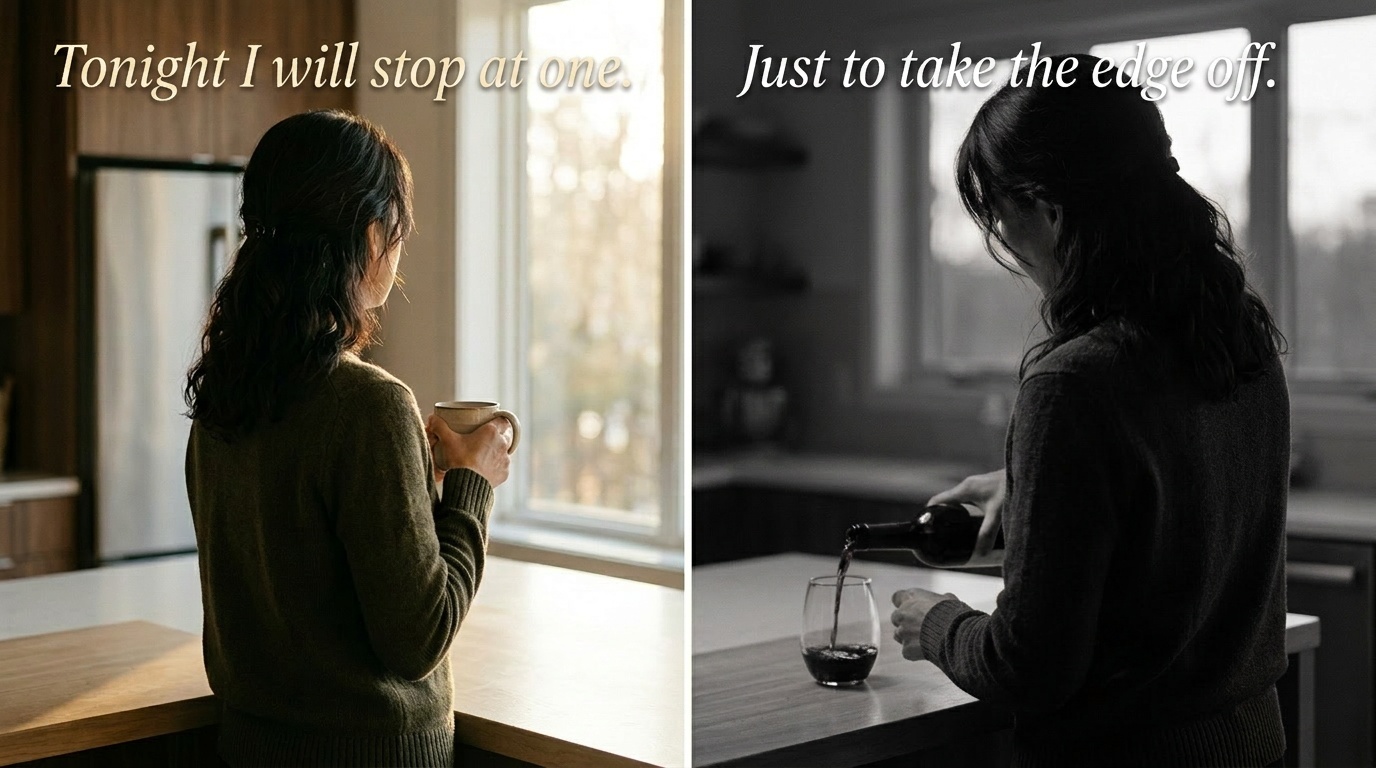
You have promised yourself you will cut back a hundred times. Here is what is physically happening in your brain and your liver every night you try, and why your willpower keeps losing.
It does not happen every night. But it happens most nights.
The pour at 7:47pm. The second glass before dinner is over. The third one you only half remember opening. The quiet deal you make with yourself on the way upstairs that tomorrow will be different.
Tomorrow is different, sometimes. Thursday you made it until 9. Last Monday you drank sparkling water through dinner and felt proud enough to mention it to no one. The pattern is not total. It is not dramatic. Nobody at work would guess. Your partner has stopped commenting. The bottles in the recycling get walked out separately from the other bottles.
You have told yourself, with increasing frequency, that you are going to cut back. You have told yourself this enough times that you have stopped believing the telling.
You are not drinking because you lack willpower. You are drinking because your reward pathway has been physically rewired to expect the pour, and your willpower has nothing left to override at 7:47pm.
You are not a drunk. You are a competent adult who has been running on emotional fumes, and the only thing that reliably turns the volume down is the glass at 7pm. That is a real problem with a real mechanism, and for the first time, a real off switch.
This article is not going to ask you to quit. It is going to explain, with specifics, what the drinking is actually doing to your brain and your liver, why willpower has a physiological expiration date that you have probably already passed, why the apps and the books and the coaching programs work for some people and not for most, and what the research has quietly been establishing for the last twenty years about an overlooked plant root that appears to do something that does not require a prescription.
By the end, you will understand what is happening inside your body on the nights you try to stop and cannot. And you will know exactly what is available to you outside the two options your doctor has probably already mentioned.
Three questions, answered honestly, right now
Before you keep reading, ask yourself these three.
- Do you pour the first glass between 6pm and 8pm almost every night, without actively deciding to?
- Does the fridge, the couch, or a specific lamp in the room feel like a pull you cannot quite describe?
- Have you told yourself "tonight I will stop at one" more than three times in the past month?
If you said yes to any one of these, you are not dealing with a willpower problem. You are dealing with a learned loop. Keep reading. This is what your brain is doing at 7pm, and how Crave Away quiets it.
The Tuesday Night You Have Stopped Thinking About

There is a specific pattern to it. You come home. You open the fridge. You are not hungry. You pour something. Maybe you say it is to take the edge off dinner prep. Maybe you say it is to celebrate closing the laptop. Maybe you say nothing at all because the conversation with yourself has become too familiar to bother with.
The first drink is a choice. You remember choosing it.
The second drink is less a choice than a continuation. The glass was empty. You refilled it on the way to sit down.
The third drink is where the research gets specific. At roughly the 90 minute mark of consistent nightly drinking, your brain has already released the dopamine pulse that was the point, and the prefrontal cortex, the part of your brain that runs the internal debate about whether this is a good idea, has been measurably down regulated by the alcohol already in your bloodstream. You did not stop choosing. Your choosing system went partially offline.
This is not a character flaw. This is what the molecule does.
If this pattern reads like a description of your evenings, you are not unusual. RAND Corporation, 2020, JAMA Network Open. Analysis of a nationally representative U.S. sample of 1,540 adults, comparing May 2020 to a pre pandemic baseline, found heavy drinking episodes among American women rose 41 percent in the three month measurement window. A follow up RAND cohort published in 2022 documented a sustained rise in alcohol related problems across adults 30 to 65, concentrated among people drinking at home rather than in bars. Off premise alcohol sales in the United States jumped sharply during the same window while bar and restaurant alcohol sales fell. The shift did not reverse.
You are part of a quiet epidemic that does not look like an epidemic because it does not happen in bars. It does not look like a drinking problem because it does not look like anything. It is just Tuesday. Again. The 7pm Override is running through millions of kitchens at roughly the same time every night, and the only reason it has no name on your chart is that it does not yet have a billing code.
What The Drink Is Actually Doing, At Neuron Level
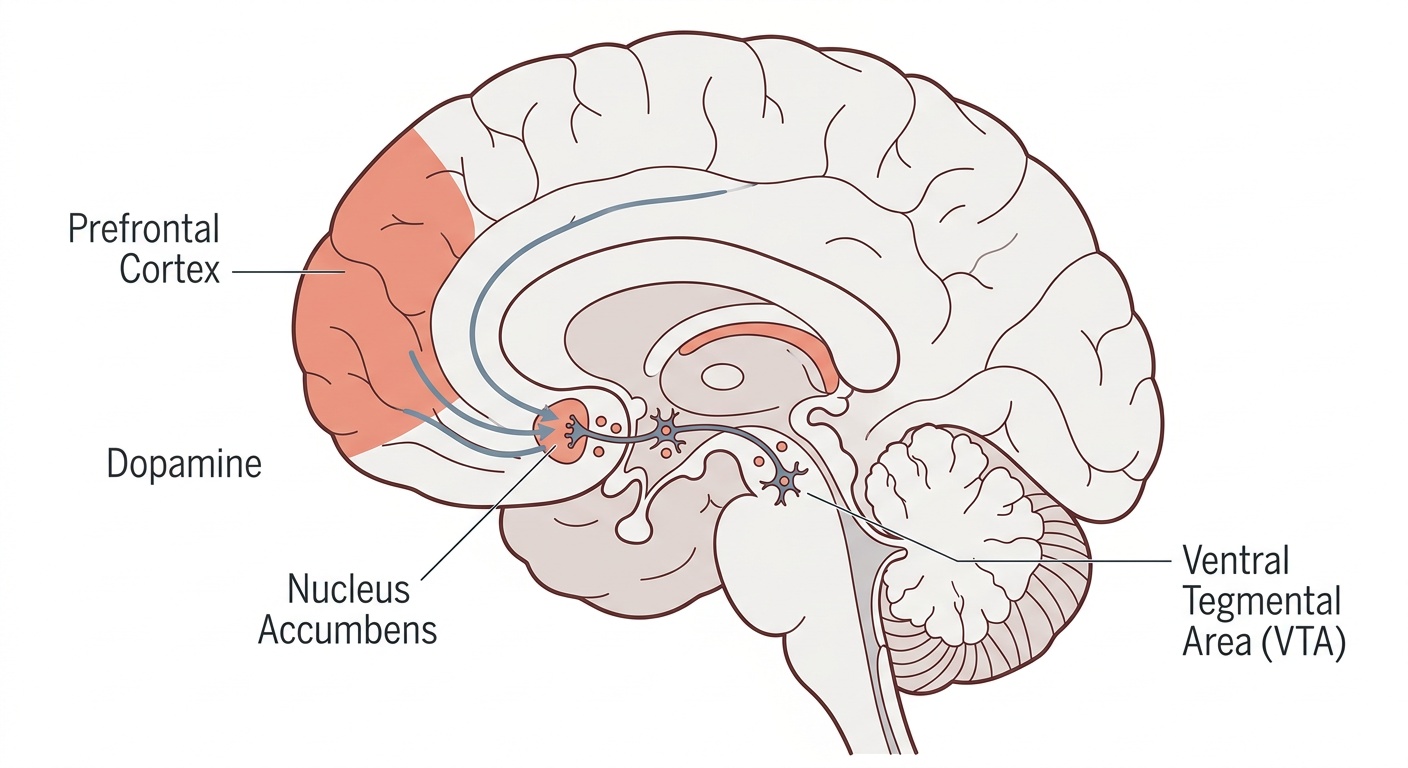
Alcohol, at the molecule level, is a dirty drug. It hits roughly eight different neurotransmitter systems at once. But the one that matters for the question of why you cannot stop at one is the reward pathway.
Here is the short version. Alcohol enters your bloodstream within minutes of the first sip. It crosses the blood brain barrier, reaches a cluster of dopamine producing neurons in a region called the ventral tegmental area, and causes them to fire. They send dopamine to a downstream region called the nucleus accumbens, which is the part of your brain that registers "that was good, do it again." This is the same pathway that fires when you eat something sweet, when you win money, when you have sex.
The first few times you drank, years ago, this pulse was a novelty. Your brain had no baseline for it. The feeling you got was genuine euphoria, because the dopamine release was unexpected and large relative to your brain's prior experience.
What has been happening, quietly, every night since, is that your brain has been adapting to the pulse. It is doing what brains do when exposed to the same stimulus repeatedly. It is adjusting the baseline. It is manufacturing fewer natural dopamine receptors, because it has concluded that the alcohol will do the job for them. It is raising the volume on the "need" signal and lowering the volume on the "satisfied" signal.
This is called reward pathway down regulation, and it is the physiological name for what you experience as "I used to feel good after one glass, now I need three before I feel anything."
The down regulation is measurable on an MRI. It is also partially reversible, but the rate of reversal is painfully slow compared to the rate of adaptation. A brain that has been drinking nightly for years appears to need months of consistent reduction, not weeks, to approach its pre drinking baseline receptor density. The exact timeline is still under active study. Imaging work in the NIAAA research literature and subsequent follow up cohorts show meaningful recovery tracking in months rather than weeks, with continued improvement observed beyond the one year mark.
This is why the mornings after the nights you promised yourself you would not drink are the hardest. Your brain is not craving alcohol. Your brain is craving the dopamine level it has learned is normal, and alcohol is the shortcut it has learned reaches that level. Every other shortcut, the work win, the good meal, the workout, the conversation, now feels flatter than it used to. Because it is flatter than it used to be. The baseline has moved.
You did not become weaker. You became chemically adapted. The next pour is not a failure of will. It is the path of least resistance through a reward system that has been re calibrated around an input your body expects.
This is not willpower. This is not weakness. This is not a character flaw.It is a learned loop your brain installed while you were busy doing everything else. Call it what it is. The 7pm Override.
From this point on, we are going to call the whole system by one name. The 7pm Override is the combination of an anticipatory dopamine pulse that starts building in the late afternoon, a prefrontal cortex that is already down regulated before the first sip, and a behavioral cue loop tied to the hour, the room, and the fridge door. Every night you cannot explain is The 7pm Override running on schedule. Every morning promise you cannot keep is the version of you without The 7pm Override trying to negotiate with the version of you inside it.
You are not losing an argument with yourself. You are losing an argument with a circuit your brain wired on its own.
The Liver Does Not Warn You
You probably had your liver enzymes checked at your last physical. You probably looked at the number, saw it was inside the "normal" range, and moved on.
The reference range for ALT, the most commonly flagged liver enzyme on a routine panel, is 7 to 56 U/L. Anything inside that window gets a green check on the lab report and a nod from your physician.
Here is the quiet part.
That range was established decades ago in a population that included people who already had elevated enzyme levels from undiagnosed fatty liver disease. Prati et al., 2002, Annals of Internal Medicine. Working from a cohort of 6,835 blood donors screened to exclude every known risk factor for liver injury, the authors proposed a true healthy upper limit of 30 U/L for women and 30 U/L for men, substantially below the 56 U/L clinical flag most labs still print on the report two decades later. Under the more conservative threshold, a 45 year old woman with an ALT of 47 is inside the "normal" window, receives no flag, and may already be in the early stages of hepatic steatosis.
More importantly, the number moves before the damage shows up.
The quiet progression
A person who drinks one bottle of wine a night, five nights a week, typically has an ALT reading in the high 20s at age 35, the mid 30s at age 40, the mid 40s at age 45, and receives their first clinical flag somewhere in the late 40s or early 50s. By the time the number crosses the clinical threshold, their liver has been accumulating fat for roughly a decade.
Illustrative ALT drift, one bottle a night pattern
Illustrative only, not individual prognosis. Clinical flag threshold on most labs is 56 U/L. Prati and colleagues argue the true healthy ceiling is closer to 30 U/L. Either way, the number moves years before your physician flags it. Ask for your actual number and track it.
Fatty liver disease is, at the early stages, completely asymptomatic. No pain. No fatigue you would attribute to the liver. No yellowing. Nothing. This is true by design. The liver is the most mechanically silent organ in the body. It does not have pain receptors along its parenchyma. It does not send warning signals when it is overloaded. It adapts. It continues adapting. And then, at some threshold specific to your genetics, your sex, and your cumulative exposure, it stops adapting.
The progression from asymptomatic fatty liver to fibrosis to cirrhosis is measured in decades for most drinkers. Which means the decision to cut back in your 40s is the decision that determines whether you get the diagnosis in your 60s.
You will not feel the damage until somewhere past the point where most of it is reversible.
If you have not had your GGT checked, not just your ALT, ask for it at your next physical. GGT moves before ALT in chronic drinkers and it is not on most standard panels.
Why Willpower Keeps Losing The Argument
Willpower is a prefrontal cortex function. The prefrontal cortex is the last region of the human brain to fully develop and the first to be impaired by alcohol already in the bloodstream.
What this means in practice is that your willpower is only available to you before the first drink. Once you have had the first drink, the part of your brain that was going to talk you out of the second drink has been pharmacologically dimmed.
This is why "I will have one and stop" almost always becomes two.
It is also why the mental strategies that work for other behavior changes, the commitment devices, the if then planning, the visualization, the journaling, tend to work in the morning and fail in the evening. The person making the plan at 9am is not the same person being asked to execute the plan at 7:47pm. The evening version of you has a partially impaired prefrontal cortex before the first sip, because the reward pathway has been anticipating the pour since around 5pm, and the same anticipatory dopamine release that was the beginning of the addiction is also the chemical signature of reduced impulse control.
You are not, in any useful sense, the same person in the morning as you are in the evening. The apps that try to rely on morning you to keep evening you in check are trying to enforce a contract between two neurochemically distinct agents who do not share the same priorities.
This is the layer that behavioral interventions do not reach. This is where The 7pm Override lives, and this is where Crave Away works.
Why The Apps And The Books Worked For Someone And Not For You
The coaching programs, the habit trackers, the digital reframing tools, the books, all operate at the cognitive layer. They teach you to notice the craving. To name it. To ride it out. To substitute a different behavior. To journal the trigger. To visualize the consequence.
This is real work and, for a minority of drinkers, it is sufficient. Specifically, it is sufficient for drinkers whose pattern is emotional rather than chemical, whose reward pathway has not yet substantially adapted, and whose prefrontal cortex remains fully functional at 7:47pm.
If you are reading this article, you are probably not in that group.
The cognitive interventions fail where they fail because they do not address the physical layer. The dopamine receptors that have been down regulated are not regulated back up by a mindfulness exercise. The ventral tegmental area does not un learn the association between 7:47pm and a pour because you wrote about it in a journal. The pharmacologically reduced impulse control at 8:03pm is not restored by the breathing technique you practiced in the morning.
The apps are not a scam. They are a tool for a problem that is partially cognitive. Your problem, if you are reading this, is probably not partially cognitive. It is mostly chemical.
This is not a failure of the tool. It is a category mismatch. Apps are built for behavior. The 7pm Override is built into chemistry. You need an intervention at the layer the problem lives at. Crave Away is that intervention.
The Prescription You Were Probably Not Offered
The pharmacological option your doctor has almost certainly not brought up, unless you directly asked, is naltrexone.
Naltrexone is an FDA approved opioid receptor antagonist that has been prescribed for alcohol dependence since 1994. It works by blocking the opioid receptors in the brain that mediate part of alcohol's reinforcing effect. The COMBINE trial, 2006, JAMA. A multi site randomized study of 1,383 patients over 16 weeks at 11 academic medical centers, found naltrexone cut the hazard of returning to any heavy drinking by roughly 28 percent among compliant patients. That is a clinically meaningful effect for a single agent, which is why naltrexone remains on the formulary. It is also why most of the drinkers who could benefit from it never hear about it.
There are three reasons your doctor may not have mentioned it.
First, naltrexone carries a side effect profile that includes nausea, headache, fatigue, dizziness, and elevated liver enzymes at higher doses. The FDA label requires baseline liver function tests before prescribing and periodic monitoring during treatment. Not every primary care physician is comfortable managing that.
Second, it is categorized as a treatment for alcohol use disorder, which is a formal clinical diagnosis with criteria most moderate drinkers do not meet. If you are drinking nightly but functional, your chart probably does not have the diagnosis on it, and naltrexone is not typically prescribed off label for "I would like to cut back."
Third, naltrexone is most effective when combined with counseling, and many primary care practices are not set up to coordinate that referral. The path of least resistance for a busy primary care physician is to note the drinking in the chart, recommend reduction, and schedule a follow up in six months.
Naltrexone is the right option for some drinkers. It is particularly the right option for drinkers whose goal is total abstinence and who have tried cutting back without success. For the broader group whose goal is reduction rather than abstinence, who are not comfortable with the prescription model, who do not want a medication that requires liver monitoring, the tool has been, until recently, limited.
The Plant That Harvard Researchers Kept Studying
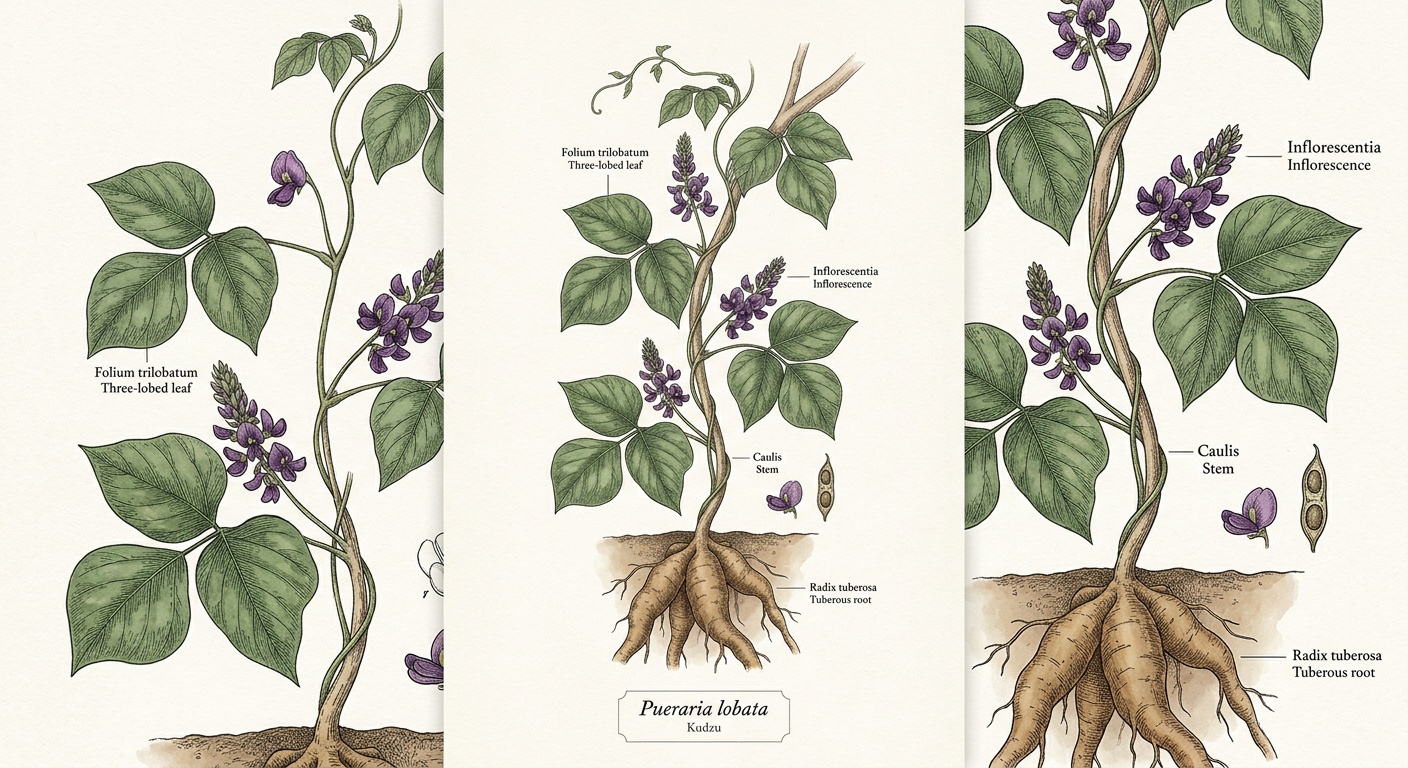
In 1993, a researcher named Scott Lukas at Harvard's McLean Hospital began a research program on a plant that had been used in traditional Chinese medicine since roughly 600 AD as a treatment for alcohol intoxication and what we would now recognize as alcohol dependence.
The plant is Pueraria lobata. Common name, kudzu. The active compound is an isoflavone called puerarin.
Over the next twenty years, the Lukas laboratory, and later the laboratory of his colleague David Penetar, published a series of human clinical trials that are unusual in the supplement research field for their methodological quality. They were randomized. They were placebo controlled. They were double blinded. They used heavy drinking subjects in naturalistic lab settings with unlimited access to alcohol, and they measured actual drinking behavior, not self reported drinking intention.
The results, published across peer reviewed papers in Alcoholism: Clinical and Experimental Research, Psychopharmacology, and Drug and Alcohol Dependence between 2005 and 2015, were consistent.
Subjects given puerarin drank fewer total beers per session. They took longer sips. They drank them more slowly. They reached a subjective sense of satiety earlier and stopped drinking earlier. The effect was measurable within the first week of dosing. It did not depend on the subject's intention to drink less. They simply drank less without reporting that they were trying to.
Penetar et al., 2015, Drug and Alcohol Dependence. Harvard McLean Hospital laboratory. Placebo controlled crossover study of 20 heavy drinkers in a naturalistic lab setting with unlimited access to alcohol. The group given a single dose of standardized kudzu extract reduced beer consumption by roughly 35 percent over one evening session versus placebo, within a single 90 minute window, without any behavioral counseling, any journaling, any cognitive intervention. The subjects were told they were in a study on alcohol metabolism. They were not told to drink less. They drank less anyway.
This is the specific property that separates kudzu from every other supplement marketed to the nightly drinker. Most of them operate at the nutritional layer, replacing micronutrients burned off by drinking, or at the metabolic layer, attempting to prop up liver function. Kudzu, alone among commonly studied botanicals, appears to act directly on the reward pathway itself, which is where The 7pm Override actually lives.
How Puerarin Works On The Layer That Apps Cannot Reach
The exact mechanism is not fully settled. The leading hypothesis, supported by the Penetar studies and by subsequent animal work, is that puerarin increases blood flow to the brain's reward centers such that alcohol reaches the nucleus accumbens slightly faster and at slightly higher concentration per unit of alcohol consumed.
The practical consequence is counterintuitive. A person taking puerarin gets the reinforcing effect of alcohol faster and more completely than a person who is not. Which means they hit the subjective "that was good, I am satisfied" signal after fewer drinks.
You can think of it as bringing the receipt of the reward forward in time. The first glass feels like what the third glass used to feel like. The second glass feels like what the fourth used to feel like. The pull to keep drinking drops not because you talked yourself out of it but because the reward signal your reward pathway was chasing has already been delivered.
This is the mechanism behavioral interventions cannot reach. It is also why the research subjects were not told to drink less and drank less anyway. The decision to stop was not a cognitive decision. It was a signal from a satisfied reward system.
Kudzu does not block the euphoria. It does not cause aversion. It does not make alcohol taste bad. It does not interfere with the first drink. It simply appears to shift the satiety point earlier in the sequence, which, for a person whose entire pattern is that they cannot stop at one, is the exact intervention the pattern requires.
The Four Anchors Of The 7pm Override
The reason most interventions fail is that they only address one anchor of the four that are holding the pattern in place. The 7pm Override is not one thing. It is four things braided together. Unbraid all four and the pattern comes apart. Pull on one and it snaps back.
Dopamine memory
The reward pathway has learned, over hundreds of evenings, that the pour at 7:47pm is followed by a dopamine pulse. It begins anticipating the pulse in the late afternoon. This is the chemistry layer. Mindfulness does not reach it. Journaling does not reach it. Apps do not reach it.
This is the anchor Crave Away targetsCortisol cliff
Your stress hormone climbs through the workday and drops off a cliff at the end of it. The body looks for something to flatten the drop. Alcohol, at the exact dose of the first glass, is one of the most efficient tools ever discovered for flattening the cortisol cliff. This anchor is physiological, but it also responds to sleep, movement, and evening light exposure once the chemistry layer is no longer screaming.
GABA shortfall
GABA is the calming neurotransmitter. Chronic evening drinking trains your body to under produce it, because the alcohol is doing the calming for it. This is why the first few evenings without a glass feel physically louder, not just emotionally harder. Your own calm system has been outsourced.
Behavioral cue loop
The fridge door. The couch. The specific lamp. The 7pm clock check. Each of these has been paired with the pour so many times that the cue alone now triggers the anticipatory dopamine pulse. The environment is running the decision, not you.
This is the honest framing of why Crave Away works where apps do not. Crave Away does not pretend to address all four anchors. It targets Anchor 1, the chemistry layer, which is the anchor that behavioral interventions physically cannot reach. And once Anchor 1 has moved, the work you can do on Anchors 2, 3, and 4 starts working again. The journaling starts landing. The mindfulness actually quiets something. The apps start feeling useful. Because the chemistry is no longer drowning them out.
Fix the chemistry first. Everything else you have already tried starts working again.
Before you bail on this as something that will not work for you specifically
- Even if you have tried dry January and bailed by day 11.
- Even if you do not consider yourself a drinker and only pour on the nights that got long.
- Even if your doctor has never flagged anything on a liver panel.
- Even if you have already done the apps, the journals, the podcasts, and the books.
- Even if you have promised yourself the same promise so many times the words have gone soft.
- Even if you think your version of this pattern is milder than the version in the studies.
The 7pm Override does not respond to any of those. It responds to one thing: the neurotransmitter pattern underneath it going quiet. That is the layer Crave Away works on, and it is the only layer that has to move for the rest of your evening to change.
What Happens If You Do Nothing
This is the section the apps and the coaching programs tend to skip, because the commercial logic of a positive reframe punishes honesty about the trajectory.
The trajectory, for a 42 year old drinking one bottle of wine a night five nights a week, looks like this.
Year 1 from today
You are roughly where you are now. Sleeping poorly but managing. ALT trending up inside the normal range. Probably three to five pounds heavier than you would be otherwise. The only people who notice the drinking are the ones you live with.
Year 5
ALT has probably crossed the clinical flag threshold. Your primary care physician has mentioned it twice. You have had one conversation about cutting back that ended with you nodding and not changing anything. Resting heart rate is elevated. You have developed, quietly, the early signs of hepatic steatosis, which will show up on any imaging that looks for it but which will not be looked for unless there is another reason to image.
Year 10
The steatosis has progressed to mild fibrosis in a meaningful share of drinkers with your pattern. The exact rate depends on genetics, sex, and cumulative exposure, but fibrosis is not a rare outcome in long term nightly drinkers, and it is substantially more common in women at lower cumulative doses than in men. You have had your first conversation with a specialist. You have been told, in language that does not sound alarming, that you need to cut back. You are now 52 and your reward pathway has been chemically adapted to a nightly alcohol input for fifteen years. The cutting back, at this stage, is substantially harder than it would have been at 42.
Year 15
The fibrosis has progressed or it has not. If it has progressed, you are now in the category of patients monitored for cirrhosis. If it has not, you have been one of the lucky ones, and you have spent a decade and a half in a pattern that was, on paper, modifiable at any point, and which you did not modify because at no point did the symptoms feel urgent enough to force the modification.
The cruelty of the alcohol consumption trajectory is that it never presents as urgent. It presents as the same Tuesday evening it was last year. The damage is cumulative. The intervention window is always now. And the person most reliably sabotaged by the delay is the person who keeps telling themselves they will cut back starting Monday.
Where This Leaves You
You have three options from here, and only three.
The first is to keep doing what you are doing. This is the default option. It does not require any decision. It produces the trajectory described above.
The second is to pursue the prescription pathway. This means asking your physician specifically about naltrexone, accepting the monitoring requirements, accepting the side effect profile, accepting the clinical framing that comes with a formal alcohol use disorder workup. It is the right option for some drinkers, particularly those whose goal is complete abstinence.
The third is to try a non prescription option that works on the same physiological layer as the medication but without the prescription, the monitoring, or the clinical framing. This means trying an oral puerarin supplement, at a dose consistent with the published Lukas and Penetar protocols, for a long enough window to judge the effect against your own baseline.
Cloud9 Crave Away is built around this third option. It is a standardized kudzu root extract, formulated at a dose range consistent with the published clinical research, produced under cGMP standards, third party tested for purity. It is not a treatment for alcohol use disorder. It is not a substitute for medical care if you need medical care. It is a tool for the category of drinker for whom the problem is not a decision problem, it is a chemistry problem, and for whom the intervention needs to happen at the chemistry layer.
The trial window is long enough to form an opinion grounded in your own evenings rather than somebody else's review.
If you are the kind of person who reads 3,000 words before making a decision, the next step is to read the research and try it inside the refund window.
What is inside Crave Away

- Standardized kudzu root extract (Pueraria lobata) at the dose range from the Lukas and Penetar clinical research
- No prescription, no liver function tests, no appointment required
- Non habit forming. Does not block alcohol. Does not cause aversion
- cGMP manufactured and third party tested for puerarin content, purity, and heavy metals
- 60 day money back guarantee. Full refund if your evenings have not changed, no questions
The First Week, The First Month, The First Six Months
Here is what the published research and observational data suggest happens on a standardized kudzu protocol at the dose range used in the Lukas and Penetar studies. We are going to walk you through it in two passes. First the night by night feel of the first month, because that is the window where most people decide whether Crave Away is working. Then the longer arc out to six months, because that is the window where the reward pathway actually recalibrates.
The first month, night by night
The pull toward the fridge is still there. You feel it. You pour the glass. Crave Away is already in your system. You will not notice anything dramatic. The edge of the craving is a degree softer, but you are not looking for it yet.
The second glass is the first thing you notice. You poured the first on autopilot. The second did not arrive on its own the way it usually does. You had to actually reach for the bottle. You probably still did. But you had to.
This is the night most people write to us about. The hand reach toward the bottle slows. You catch yourself mid motion. For the first time in months, or in years, there is a pause between the cue and the pour. Inside that pause is the entire mechanism The 7pm Override had been running through, and Crave Away is the thing that quietly created the pause.
The glass starts to feel like a choice instead of a reflex. Some nights you pour two. Some nights you pour one. Some nights you do not pour at all and do not notice until you are in bed. You are not white knuckling anything. The decision is quieter because the chemistry underneath the decision has moved.
The 7pm Override is quieter than the rest of your evening. The routine that ran your evenings for years is no longer running them. You still enjoy the first glass on the nights you pour one. You simply do not need the second.
That is Month 1. Crave Away has now worked. The harder question is not whether it works, but how deep you want the recalibration to go. For that, here is the longer arc.
Week 1 · The first shift
Based on the Lukas and Penetar clinical data, most people on Crave Away report the first change inside the first 5 to 7 days. The second glass feels less necessary. The third glass often stops happening on its own. You are not fighting the pull. The pull is arriving with less intensity.
W4
Weeks 2 to 4 · The new baseline
Evenings settle into a new pattern. Most people drop from 3 to 4 drinks per sitting to 1 to 2 without consciously restricting. Sleep quality improves as alcohol clears the system earlier in the night. The 7:47pm anticipatory dopamine pulse begins to weaken because your brain has less reason to expect the pour.
M3
Months 2 to 3 · The liver catches up
Observational data in moderate drinkers who cut consumption by half or more show ALT and GGT readings measurably improving in this window. Deep sleep consolidates into longer blocks. Resting heart rate drops. Morning energy is noticeably higher. The face in the mirror looks different.
M6
Months 4 to 6 · The reward pathway recalibrates
This is the window where imaging research suggests baseline dopamine receptor density begins measurably recovering, though the exact timeline varies by individual and continues under active study. The craving you used to feel at 5pm becomes quieter. The decision at 7:47pm feels like the decision between tea or wine, not between resistance and surrender. Your default has moved.
After month 6 · The new normal
You are not white knuckling the absence of drinking. The pull is not the same pull. For most people, a natural pattern of 1 to 2 drinks on a few nights a week becomes the default, not a performance. The Tuesday night you stopped thinking about is quietly no longer a problem.
Why Most People Choose The 6 Month Protocol
There are three reasons the 6 month supply is the most popular option for readers whose goal is lasting reduction rather than a quick trial.
1. The biology. Imaging research on dopamine receptor density suggests the reward pathway needs months of consistent reduction, not weeks, and continued improvement has been observed well past the one year mark. A 30 day bottle of Crave Away gives you the first signal. The fuller recalibration window does not open until somewhere around month 4 and continues past month 6. Starting with a 6 month supply of Crave Away means you hold a meaningful recalibration window in your own kitchen before you have to decide anything.
2. The motivation curve. The biggest predictor of failure in any behavior change is the drop off between day 45 and day 90. This is the point where the original motivation has faded, the early wins have become the new normal, and "should I re-order" sits at the bottom of a to-do list that never actually reaches it. People who already have Crave Away in the cupboard simply continue. People who run out at day 32 and have to re-decide do not continue at the same rate.
3. The cost of interruption. The effect of Crave Away on the reward pathway is cumulative. Stopping and restarting resets a portion of the receptor density gains you already paid for in weeks of consistent dosing. A continuous 6 month window of Crave Away protects the investment the first 30 days bought you.
MONTH 1
MONTH 2
MONTH 3
MONTH 4
MONTH 5
MONTH 6
One bottle per month. Six bottles in the cupboard is six decisions you do not have to make again.
The honest price comparison
A decent bottle of wine in most U.S. zip codes runs $15 to $25. A bottle a night, five nights a week, is $3,900 to $6,500 a year poured into a habit you are trying to stop. That number does not include the coaching app, the hangover supplements, the replacement dinners out, or the cost of the 7pm Override compounding in the background of the rest of your life.
↓Crave Away on the 6 month protocol works out to roughly the price of one glass of wine a week. Less than a dollar a day to turn the anchor Crave Away targets back down to the baseline your reward pathway used to run on. You are not adding a cost. You are redirecting one you are already paying.
1 month, 3 month, or 6 month supply · 60 day money back guarantee
Questions You May Still Have
Will I still be able to drink on this?
Yes. Kudzu does not block alcohol and does not cause aversion. It does not interfere with the first drink. It appears to shift the satiety point earlier in the sequence, so you are likely to stop sooner on your own, not forced to stop.
How long until I notice a change?
The Lukas and Penetar studies reported measurable differences within the first week of dosing. Most people report a shift in their evenings inside the first 7 to 14 days, though the fuller effect takes four to six weeks as your reward pathway recalibrates.
Can I take this with my current medications?
Kudzu has a clean interaction profile for most common medications. If you are on methotrexate, tamoxifen, blood thinners, or any medication with a narrow therapeutic window, check with your physician first. Not for use if you are pregnant, nursing, or under 21.
Is this the same as the kudzu gummies on Amazon?
No. The generic kudzu products on Amazon are mostly unstandardized powder with no guarantee of puerarin content. Cloud9 Crave Away uses a standardized extract in the dose range from the published research, cGMP manufactured, third party tested. Dose and standardization matter. Most generic Amazon products are significantly under dosed relative to the clinical protocols, and many do not publish the puerarin content on the label at all.
Do I have to identify as an alcoholic to take this?
No. This is not a treatment for alcohol use disorder. It is not a 12 step pathway. It is a supplement for people who want to drink less and whose reward system is making "less" harder than it should be. You do not need a diagnosis, a label, or a meeting.
What if it does not work for me?
Every order of Crave Away is covered by a 60 day money back guarantee. If your evenings do not measurably change inside the window, you return the bottle for a full refund, no questions asked. The trial is on us.
Will my partner notice anything?
Probably not the pill. Almost certainly the pattern. The people living with a nightly drinker are trained to track the second pour before they consciously register they are tracking it. When the second pour stops arriving on its own, partners tend to notice the silence around the refill before they notice anything else. No conversation is required. Most readers who use Crave Away do not tell anyone they are using it until the pattern has already moved.
How is this different from naltrexone?
Naltrexone is an FDA approved opioid receptor antagonist that blocks part of alcohol's reinforcing effect. It requires a prescription, a baseline liver function test, and periodic monitoring, and it is written inside a clinical framing most moderate drinkers do not want on their chart. Crave Away is a standardized kudzu root extract that works on a different mechanism, appears to shift the satiety point earlier in the drinking sequence rather than blocking the reward, does not require a prescription, and does not require liver monitoring. Naltrexone is the right tool for drinkers targeting abstinence under clinical supervision. Crave Away is the right tool for drinkers whose goal is reduction and who would rather quiet The 7pm Override than ratify it with a diagnosis.
What if I drink more than a glass or two a night?
The Lukas and Penetar studies were specifically designed around heavy drinkers with unrestricted access to alcohol in a naturalistic lab setting. The effect size reported in the Penetar 2015 paper, roughly a 35 percent reduction in a 90 minute window, was measured in that population. If your current pattern is a full bottle of wine or three to four drinks most evenings, you are closer to the study population than a one glass a night drinker. Crave Away is built for your pattern, not a lighter one.
What happens if I stop taking Crave Away?
The effect on the reward pathway is cumulative while you are dosing. Stopping after 30 days will give up a portion of the receptor recalibration you had been building. Most readers who have seen the 7pm Override quiet down choose to stay on a maintenance dose through the six month window, because the cost of a second recalibration is substantially higher than the cost of continuing the first one.
You are standing in front of two doors.
Door 1
You close this page. Tonight at 7:47pm the pour happens again. Tomorrow you tell yourself Monday. In five years you are looking at the same kitchen, the same bottle, and a lab report you did not want to read. Nothing has asked anything of you. Nothing has changed either.
Door 2
You try one bottle of Crave Away inside the 60 day refund window. You measure the next 30 evenings against the last 30. If The 7pm Override is still running at the same volume, you send the bottle back and you are out nothing. If it is not, you keep going, and the person who picks the wine glass up at 7:47pm three months from now is no longer running on a circuit they did not install.
We did not build Crave Away because we think you are broken. We built it because the people we love are the ones pouring the 7pm glass, and the ones we listen to in the kitchen are not asking to be rescued. They are asking for the chemistry underneath the glass to go a little quieter so the rest of the evening can come back.
The Tuesday you are picturing for yourself is not going to schedule itself.
Start Crave Away now, or start fifteen years from now.
60 day money back guarantee · Free US shipping · Pause or cancel anytime
References
- Lukas SE, Penetar D, Berko J, et al. An extract of the Chinese herbal root kudzu reduces alcohol drinking by heavy drinkers in a naturalistic setting. Alcoholism: Clinical and Experimental Research. 2005;29(5):756 to 762.
- Penetar DM, Toto LH, Lee DY, Lukas SE. A single dose of kudzu extract reduces alcohol consumption in a binge drinking paradigm. Drug and Alcohol Dependence. 2015;153:194 to 200.
- Lukas SE, Penetar D, Su Z, et al. A standardized kudzu extract reduces alcohol consumption in nontreatment seeking male heavy drinkers. Psychopharmacology. 2013;226(1):65 to 73.
- Penetar DM, MacLean RR, McNeil JF, Lukas SE. Kudzu extract treatment does not increase the intoxicating effects of acute alcohol in human volunteers. Alcoholism: Clinical and Experimental Research. 2011;35(4):726 to 734.
- Anton RF, O'Malley SS, Ciraulo DA, et al. Combined pharmacotherapies and behavioral interventions for alcohol dependence: the COMBINE study. JAMA. 2006;295(17):2003 to 2017.
- Kim HC, Nam CM, Jee SH, et al. Normal serum aminotransferase concentration and risk of mortality from liver diseases: prospective cohort study. BMJ. 2004;328(7446):983.
- Prati D, Taioli E, Zanella A, et al. Updated definitions of healthy ranges for serum alanine aminotransferase levels. Annals of Internal Medicine. 2002;137(1):1 to 10.
- Pollard MS, Tucker JS, Green HD. Changes in adult alcohol use and consequences during the COVID 19 pandemic in the US. RAND Corporation. JAMA Network Open. 2020;3(9):e2022942.
- RAND Corporation. Alcohol Use and Consequences Across the Pandemic Years. 2022.
- National Institute on Alcohol Abuse and Alcoholism. Neuroscience: The Brain in Addiction and Recovery. Research literature.
This article is educational and not medical advice. Cloud9 Crave Away is a dietary supplement and is not intended to diagnose, treat, cure, or prevent any disease. The statements above have not been evaluated by the FDA. If you are pregnant, nursing, taking prescription medications, or have a diagnosed medical condition, consult your physician before starting any supplement. The citations are drawn from peer reviewed published literature available on PubMed.