
HEALTH · MODERATE DRINKERS · LONG READ
It is not anxiety. It is not insomnia. It is not "perimenopause again." Something quieter has been running for years, and it finally came due at 3:17 AM.

The clock says 3:17. Again.
You already know how the next forty minutes go. Heart a little too loud. A low buzz behind the eyes. A dozen things you were not worried about six hours ago suddenly urgent. The inhaler. The emails. A parent's blood pressure. You fall back asleep somewhere after four. The alarm goes at six-thirty. You drag into the day already a day behind.
By 3 PM the fog closes in. By 5 PM the daydream about the first glass starts. By 7 PM the pour happens. By 9 PM there is enough calm to go to bed.
And at 3:17 in the morning, the wake-up happens again.
If you have been running this loop for more than a year, you are not alone, you are not broken, and you are not imagining the cost. Across moderate drinkers in the 40-to-55 age range, this is one of the most common patterns on record. And it has a name almost no primary care doctor will say at the annual physical.
The part almost nobody explains: alcohol is a withdrawal, not a deposit
Most of us grew up thinking wine was a food. It sits on the dinner table. It gets paired with cheese. Our grandmothers drank it. Two glasses is basically salad dressing.
Here is the part the story leaves out.
Every glass of wine your body processes pulls a specific list of nutrients out of circulation, faster than a normal diet replaces them. Thiamine (B1). B6. Folate. B12. Magnesium. Zinc. The amino acid pools your brain uses to build serotonin. The GABA your nervous system uses to stay calm without alcohol. And the glutathione your liver uses to neutralize acetaldehyde, the compound your liver produces while it is breaking ethanol down.
Your body has a daily deposit of each of those. Food delivers some. Sleep rebuilds some. A standard day without alcohol burns through a predictable amount, and a reasonable diet more or less replaces it.
Two glasses of wine is a withdrawal that a normal deposit cannot cover.
The first week, the body absorbs the deficit. The first month, it pulls from reserves. The first year, you start feeling a little more tired than you used to. You blame your age. The second year, you start waking up at 3:17 AM and nobody can figure out why. The fifth year, your liver enzymes start to drift, your skin looks duller in the bathroom light, and your primary care doctor tells you to drink more water.
Almost nobody names what is actually happening. Here is the name. Once you see it, you cannot unsee it.
Call it The Nutrient Debt.
What The Nutrient Debt actually is
The Nutrient Debt is a quiet, compounding, multi-year shortage of the nutrients alcohol burns through faster than a normal diet can replace them.
It is not a diagnosis. Your doctor will not write it on a chart. You will not find it in an ICD code. That is part of the problem. The Debt is invisible to the standard annual physical. Your liver enzymes can look fine on paper and the Debt can still be running a decade-long deficit underneath them.
But your body knows.
The 3:17 AM wake-up is one of the clearest signals. Alcohol is a sedative for the first two hours after you drink it. Somewhere between hour four and hour six, the sedative has metabolized out and your nervous system rebounds. Cortisol climbs. GABA drops. Your heart rate lifts.
If your reserves are full, you sleep straight through the rebound and never know it happened. If the Debt is running, you wake up wide awake, low-key anxious, with no idea why.
The 3 PM crash is another signal. The Monday fog. The puffy face in the Tuesday morning mirror. The "I used to be able to drink like this" feeling that you assumed was age. Every single one of those is the Debt, not the calendar.
Here is the self-check most moderate drinkers recognize themselves in, before anything else.
The Nutrient Debt self-check
Patterns commonly noticed by moderate drinkers in the 40-to-55 window. Answer yes or no.
- You wake up between roughly 2:45 AM and 3:30 AM most nights after wine, and you cannot say why.
- Your 3 PM energy crash is worse than it used to be. Coffee barely touches it. You want something sweet and something salty at the same time.
- You notice a low buzz of anxiety the morning after even one or two drinks that has nothing to name.
- Your face looks puffier and duller the morning after wine than it did five years ago, on the same amount.
- You have been told your bloodwork "looks fine" but you do not actually feel fine.
- Monday mornings feel disproportionately hard given what you drank on Saturday.
- You forget why you walked into a room more often, especially the day after.
- You catch yourself pouring the second glass almost before the first is finished, without thinking.
- Your sleep tracker shows you dropping out of deep sleep right around 3 AM.
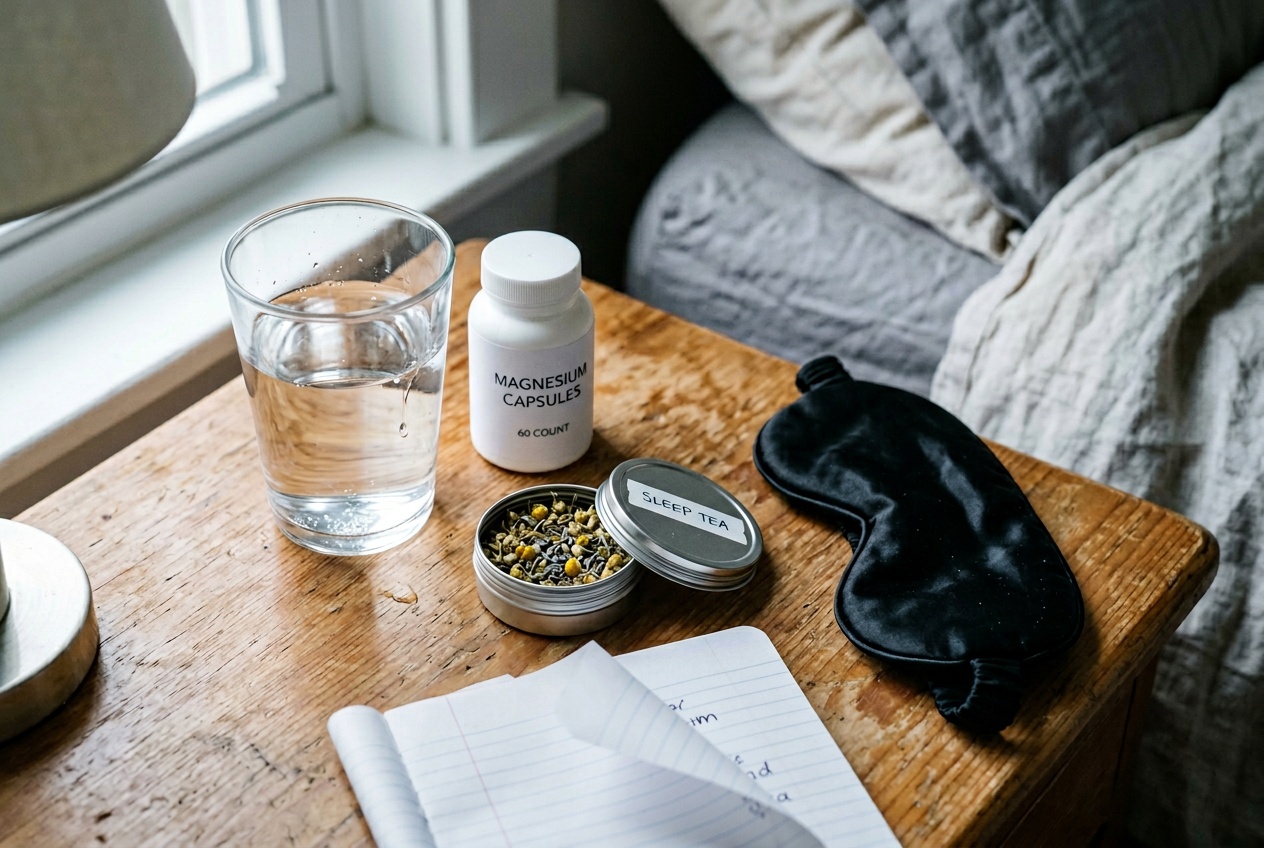
- You have quietly tried magnesium, ashwagandha, melatonin, sleep tea, and a 10 PM cutoff, and none of it holds.
- You sometimes feel slightly older than your actual age in the first hour after waking.
- You have a family history of liver, heart, or blood pressure issues and you know it but are not sure what to do about it.
Three yeses and The Nutrient Debt is probably running. Six yeses and it has been running for a while. Nine or more and it is not subtle anymore. Your body is just asking you to look at it.
Most moderate drinkers in this profile land at eleven.
Why willpower, water, and the 10 PM cutoff all fail
Almost every moderate drinker reaches for the polite solutions first.
A full glass of water between each glass of wine. Switching to a lower-ABV wine. A three-month 9 PM cutoff. A pink Himalayan salt trick. Magnesium glycinate before bed. A liver-cleanse tea from the health aisle. Milk thistle alone. NAC alone from the vitamin rack. A greens powder. A green-juice three-day reset. A dry January, then a dry February. Switching from wine to vodka soda. Switching to low-calorie wine. A sleep mask, a cooler bedroom, no screens after ten, and a gratitude journal. The 4 PM coffee that used to work and does not anymore. The second glass that gets poured before the first one is finished.
Some of it helps for a week. None of it holds.
Every one of those interventions is pointed at the wrong variable.
Water addresses dehydration, but the Debt is not dehydration. Magnesium alone addresses one mineral, but the Debt runs across the B-complex, the amino acid pools, the glutathione precursors, and the adrenal-cortisol axis at the same time.
A 10 PM cutoff addresses when you drink, not what gets stripped out by the time you do. A "cleanse" addresses nothing at all. Your liver does not need a reset. It needs the specific raw materials it ran out of three years ago.
The hardest truth hidden in The Nutrient Debt is that for years, most moderate drinkers have been pointing behavioral tools at a biochemical shortage, losing, and blaming themselves for the loss.
The second hardest truth is the one that comes next. If the shortage is the problem, the shortage is also the answer. Not a reset. Not a detox. Not a purge. A daily deposit of the exact compounds the body was running short on, in the ratios the liver and nervous system actually use.
Already sold on the mechanism? Skip ahead to the protocol →The four anchors, in the order a moderate drinker's body actually needs them
Once the willpower frame is set aside, the research organizes itself into four anchors, in order. These are the four shortages a moderate drinker is running, from most structural to most acute.
Anchor 1. Your liver is a 500-job warehouse on a part-time budget
The human liver performs more than 500 distinct functions every 24 hours, a figure enumerated across standard hepatology references including Sherlock's Diseases of the Liver and Biliary System (Dooley et al., 13th ed., Wiley-Blackwell). It filters blood. Converts food into energy. Regulates hormones. Neutralizes circulating toxins. Stores vitamins. Produces bile. Manages cholesterol. Regulates blood sugar. Clears the acetaldehyde your body makes while it is breaking down ethanol.
That last job is the expensive one.
When alcohol is in the system, the liver reprioritizes. Routine jobs get pushed back. Maintenance jobs get pushed back. When the reprioritizing happens five or six nights a week for five or six years, the backlog becomes chronic.
This is the mechanism underneath the Monday fog, the puffy face, and the dulling skin. The liver is not damaged. It is behind.
Anchor 2. The B-vitamin shortage is the fastest, the most invisible, and the most responsible for how you feel
B-vitamins are water-soluble. Which is a friendly way of saying the body does not store them. Every glass of wine raises the metabolic demand for B1 (thiamine), B6, folate, and B12, and increases their urinary loss.
If the diet does not replace them, a shortage builds in red blood cells, nerve cells, and the brain's energy pathway. That is the 3 PM crash. That is the forgetting why you walked into a room. That is the slow thinning of emotional resilience that feels like stress but is actually neurology running on low battery.
Thiamine is the quiet ringleader. Most drugstore multivitamins use thiamine hydrochloride, a water-soluble form with modest absorption. Benfotiamine is a fat-soluble form of B1 shown in published pharmacokinetic work (Loew, Int J Clin Pharmacol Ther 1996) to reach significantly higher blood levels than thiamine hydrochloride at the same dose. That bioavailability difference is the reason the cognitive-clarity lift is often reported on the benfotiamine form and rarely on the drugstore form.

Anchor 3. The serotonin and GABA floor drifts down before you notice it
Alcohol produces a small evening calming bump. That is the pleasant part. The bill comes the next day in the form of a slightly lower serotonin floor and a slightly lower GABA tone.
One night is invisible. Five nights a week for five years is the reason Sunday afternoons feel slightly flat and Tuesday afternoons feel slightly wired in a way that has no external cause.
Serotonin is built from tryptophan, then converted via 5-HTP. GABA tone is supported by L-Theanine, which has been shown in EEG studies (Nobre et al., Asia Pac J Clin Nutr 2008) to raise alpha-wave activity in the brain. Both pathways depend on B6 and folate as cofactors. Fixing one B-vitamin without the others rarely moves the needle.
Anchor 4. The 3 AM wake-up is cortisol and GABA rebound, and it responds to the right inputs
The sedative effect of alcohol wears off four to six hours after the last drink. As it metabolizes out, GABA signaling drops and cortisol climbs.
Ashwagandha is a standardized adaptogen with multiple randomized trials (for example Chandrasekhar et al., Indian J Psychol Med 2012, n=64 chronically stressed adults) showing reductions in serum cortisol versus placebo. Dihydromyricetin (DHM), a flavonoid from the Hovenia tree, has published preclinical work (Shen et al., Journal of Neuroscience 2012, rodent model) showing it supports GABA-A receptor function during and after alcohol exposure.
Together the two inputs are why the 3:17 AM wake-up is not a life sentence. It is a responsive pattern of a responsive shortage.
Responsive is the word to keep. Most of the self-check items above are associated with shortages that can be supported in the 30-to-90 day window, when the daily deposit finally exceeds the daily withdrawal.

The seven compounds, and what the peer-reviewed research actually says
Walk the published literature on moderate-drinker biochemistry long enough and the same seven compounds keep surfacing. Not a shotgun of twenty ingredients. Seven. Each pointed at one of the specific shortages in the Debt.
1. N-Acetylcysteine (NAC)
NAC is a precursor to glutathione, the molecule the liver uses to neutralize acetaldehyde. Glutathione replenishment via NAC is also the standard-of-care hospital treatment for acetaminophen (paracetamol) overdose, used since the 1970s and listed on the WHO Essential Medicines list.
Published work on NAC and hepatic glutathione in alcohol-related contexts includes Ronis et al. (Exp Biol Med 2011) demonstrating NAC-associated glutathione recovery in alcohol-exposed liver tissue, and Kasperczyk et al. (Drug Chem Toxicol 2014) showing improvements in oxidative stress markers in alcohol-exposed workers supplemented with NAC.
2. Dihydromyricetin (DHM, from Hovenia dulcis)
DHM is a flavonoid from the Hovenia tree used in East Asian folk practice for centuries. The modern research foundation is Shen et al. (Journal of Neuroscience 2012, preclinical rodent model from UCLA's Liang lab), which documented DHM's effect on GABA-A receptor function during and after alcohol exposure, together with faster alcohol clearance. Follow-up work since has supported the mechanism.
3. Milk Thistle (silymarin)
Milk thistle is the most-studied liver-support botanical in Western herbal medicine. Its active compound, silymarin, stabilizes hepatocyte membranes and supports the clearance of reactive oxygen species.
A Cochrane review (Rambaldi et al., 2007) and the Abenavoli et al. systematic review in Phytotherapy Research (2018) together summarize the long trial history of silymarin in liver-related conditions. The effect sizes are modest but consistent, which is what the Debt frame actually calls for.
4. Thiamine (Benfotiamine form)
Thiamine is vitamin B1, and it is the single most sharply affected B-vitamin in moderate drinkers. Benfotiamine is a fat-soluble form shown in Loew, Int J Clin Pharmacol Ther (1996, crossover pharmacokinetic study in healthy adults) and subsequent work (Volvert et al., 2008) to reach significantly higher blood concentrations than thiamine hydrochloride at the same dose. That is why the cognitive-clarity response shows up on benfotiamine and rarely on the drugstore form.

5. L-Theanine
L-Theanine is the calming amino acid found naturally in green tea leaves. Nobre et al. (Asia Pac J Clin Nutr 2008) showed L-Theanine raises alpha-wave activity in human EEG, and Kimura et al. (Biol Psychol 2007) showed it modulates the subjective and physiological response to stress. Unlike a sedative, it supports calm without drowsiness, which is why it can sit alongside morning coffee.
6. 5-HTP (5-hydroxytryptophan)
5-HTP is the direct serotonin precursor. Serotonin is the same molecule that downstream becomes melatonin, which shapes sleep architecture. The 5-HTP deposit is one reason the 3:17 AM wake-up is often the first thing to soften inside the first three or four weeks.
7. Ashwagandha (standardized, e.g., KSM-66)
Ashwagandha is an adaptogen with multiple randomized controlled trials on cortisol reduction in stressed adults. Chandrasekhar et al. (Indian J Psychol Med 2012, n=64 stressed adults) reported a statistically significant reduction in serum cortisol versus placebo over 60 days. Lopresti et al. (Medicine (Baltimore) 2019, n=60 adults) replicated a similar cortisol-reduction effect on a different standardized extract. In the Debt frame its job is specifically to dampen the 3 AM cortisol climb that otherwise pulls the sleeper out of deep sleep.
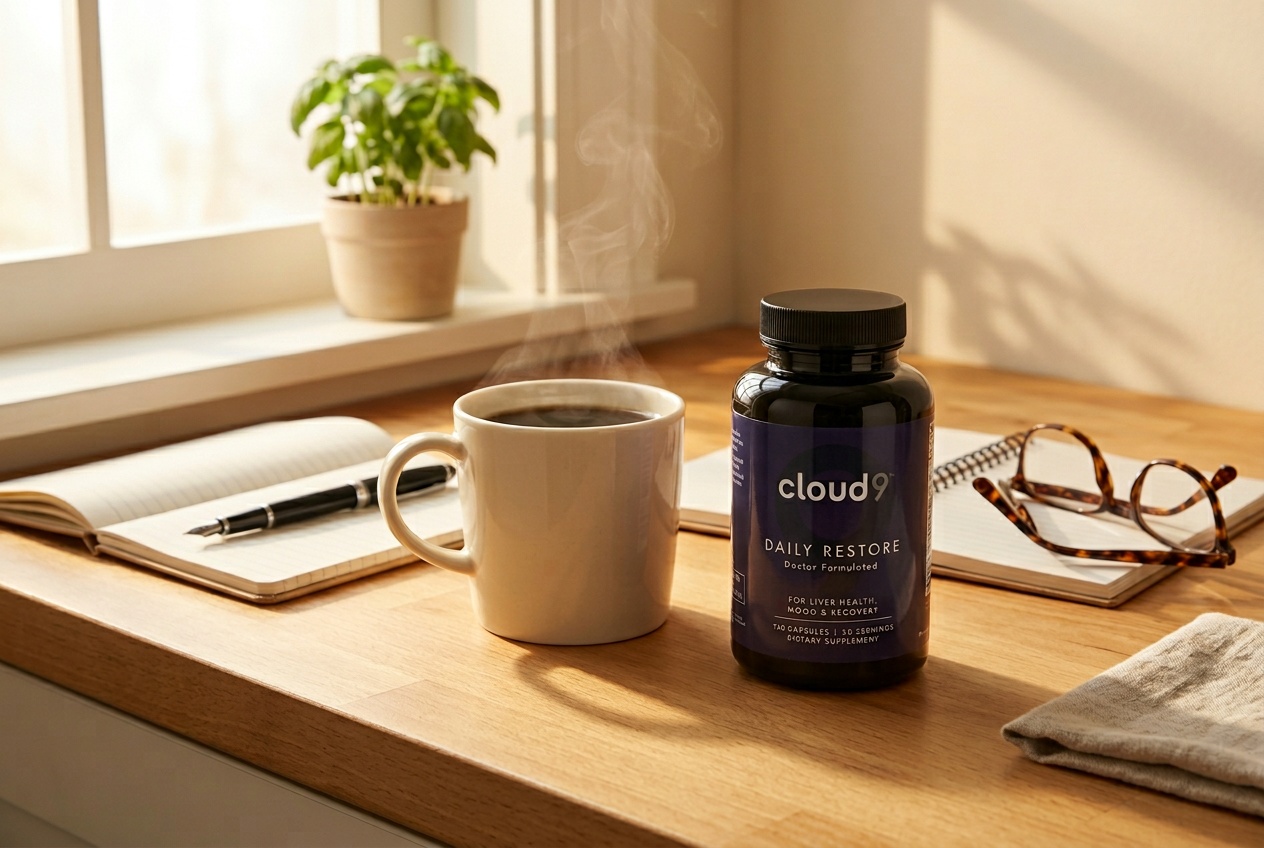
These seven compounds, in those ratios, are what goes into a daily capsule called Cloud9 Daily Restore.
Daily Restore is not a hangover pill. It is not a cure. It is not marketed as either. Daily Restore is a daily deposit against The Nutrient Debt, taken every morning with water, two capsules, with or without food. Cloud9 formulated it specifically for the moderate drinker who is not planning to quit but is tired of quietly losing to the Debt.

What actually changes, in the order it changes
The Daily Restore curve has a specific shape across the moderate-drinker profile. Two weeks of almost nothing, then one morning in the third week the 3 AM wake-up simply does not happen. A week later the Wednesday afternoon fog lifts. A month after that, the Saturday mirror stops surprising you. Ninety days out, for customers who test annually, liver function markers often trend back toward the middle of the reference range.
The order is consistent. The pace is boring. The result is not.
Day fourteen. The most common first report is a single morning that ends at 6:15 AM with no memory of a 3:17 AM wake-up. Sleep trackers often show a shorter, shallower dip around the three o'clock hour instead of a full wake.
Day twenty-one. The 3 PM crash softens. A Wednesday afternoon meeting ends without the usual under-eye fog. The absence is often noticed before the presence of anything new.
Day thirty. Morning puffiness begins to clear. The Saturday bathroom mirror stops surprising people who had two glasses of wine the night before. This is the most frequently described "I stood there for a minute" moment in Cloud9 customer interviews.
Day sixty. The 5 PM daydream about the first glass quiets. Wine at dinner is still there. It is still enjoyed. What drops out is the pre-dinner rehearsal. The most frequently named mechanism is the L-Theanine and 5-HTP taking the edge off the daily stress load so the 7 PM pull stops feeling mandatory.
Day ninety. For customers who test annually, liver function markers that had been drifting upward for two to three years often trend back toward the middle of the reference range, with no other change to diet or alcohol intake.
Nobody in this population stopped drinking. What stopped was paying the Nutrient Debt's interest every night.
On a recorded Cloud9 customer call, one long-time Daily Restore user described the same arc in almost those exact words.
"Four o'clock used to be my craving time. Yesterday? No cravings whatsoever. None. All the way to bed." She had been on the daily deposit for about eight weeks. "I'm not overindulging like I was. The other thing that's coming with the package is the reduction of quantity of drinks on the days that I choose to."
She also said something worth keeping.
"I'm proud of myself at the end of the night. The confidence in yourself, the ability to trust yourself, is really what sets up the momentum for everything else."

The 90-day curve, in plain English
If you start the daily deposit today, this is roughly what the moderate-drinker profile reports on average, across hundreds of Cloud9 customer interviews logged in the first year Daily Restore shipped.
- Days 1 through 14. Almost nothing. A few people report slightly better morning clarity in the first week. Most do not. This is the phase where the deposit catches up with the longstanding shortage. The Debt took years to build. The first two weeks are quiet math.
- Days 14 through 30. The 3 AM wake-up shortens or disappears. The 3 PM crash softens. The morning puffiness begins to clear. You feel, rather than notice, that you are slightly steadier through the afternoon.
- Days 30 through 60. The quiet evening pull eases. The second glass stops feeling mandatory. Sleep-tracker scores begin to stabilize. The Monday fog lifts. The morning mirror stops surprising you.
- Days 60 through 90. Many customers describe a steadier mood floor. Liver function markers, if tested, often trend back toward the middle of the reference range. The 5 PM craving becomes a quieter thought that can be answered or ignored. The daily capsule stops feeling like an intervention and starts feeling like a coffee-next-to-the-maker routine.
Individual results vary. The timing above reflects the most common arc across aggregated customer interviews and is not a guarantee.
This is why the protocol is designed as a protocol, not a month. The Nutrient Debt did not build in 30 days. Supporting the recovery takes longer than that.
Why the six-month protocol is the one almost everyone ends up on
When Cloud9 first shipped Daily Restore, the company offered a one-month starter bottle, a three-month protocol, and a six-month protocol. Cloud9 expected most people to take the one month, test it, and step up.
Almost nobody did.
What the actual order data showed, and what hundreds of logged customer interviews confirmed, was that the people who started on the one-month bottle and stopped at 30 days almost always came back six weeks later and bought the six-month protocol instead.
The reason is not marketing. The reason is the curve above.
30 days is the window where the deposit is finally exceeding the withdrawal. It is not where the results cement. The 60-to-90 window is where the nervous system resets its baseline. The 90-to-180 window is where the new baseline locks in and stops feeling like an intervention and starts feeling like "who you are now."
Six months is also the length of time most Daily Restore customers need for a shift in liver function markers to hold across consecutive bloodwork panels, which is the test most primary care providers actually trust.
The one-month bottle still exists. Some people want to test it first, and that is a legitimate way in. The pattern the order data actually shows, though, is that the six-month protocol is the offer almost every repeat customer ends up on, and it is priced accordingly per bottle. It is the anchor.
The Daily Restore protocol
| Option | Commitment | Best for |
|---|---|---|
| 1 bottlestarter | 30 daysabout $1.97 / day | Trying the deposit, seeing the first shift |
| 3 bottlesprotocol | 90 daysabout $1.52 / day | Completing one full curve, getting to the baseline reset |
| 6 bottles Most popularthe anchor protocol | 180 daysabout $1.18 / day · best per-day value | Locking in the new baseline across two bloodwork panels |
Every tier ships with the same 90-day money-back guarantee. Finish the bottles. If the deposit does not close the gap, send the empty containers back and the order refunds. Indicative per-day cost shown for comparison; live pricing on the Cloud9 product page.
Even if you do not believe supplements work. Most of them do not. The seven compounds in Daily Restore are the ones with actual peer-reviewed human and preclinical research behind them, in the doses that showed up in the studies, in the bioavailable forms that actually cross the barriers they need to cross. Cloud9's 90-day guarantee exists because the company is willing to put the cost of being wrong on its own balance sheet, not yours. Finish the bottles. If the deposit does not close the gap, send the empty containers back.
The Nutrient Debt is the quiet, compounding shortage that moderate drinkers have been paying interest on for years without a name for it. Daily Restore is the daily deposit against that shortage, two capsules in the morning, priced so that the six-month anchor works out to about $1.18 a day and comes with a 90-day money-back guarantee.
Ten questions readers ask most, answered
1. Is Daily Restore a hangover pill?
No. A hangover pill is a rescue taken after the fact. Daily Restore is a daily deposit taken every morning, on drinking days and non-drinking days, independent of the evening. It is closer to a multivitamin built for moderate drinkers than a recovery product.
2. Do I have to stop drinking for this to work?
No. The entire protocol is designed around moderate drinkers who are not planning to quit. The mechanism is supporting the nutrients alcohol burns through, not replacing the alcohol.
3. This sounds like an expensive multivitamin. Why does it cost more than a drugstore multi?
Because a drugstore multivitamin uses the cheapest form of every ingredient. Thiamine hydrochloride instead of benfotiamine. Standard cysteine instead of N-acetylcysteine. A magnesium oxide that barely absorbs instead of a glycinate. And no DHM, no standardized ashwagandha, no 5-HTP, no milk thistle at silymarin-standardized dose. The forms are the point. The bioavailability is why the research cited above used these forms, not the drugstore forms.
4. What if I barely drink, or do not drink at all?
The seven compounds are individually useful for liver support, energy metabolism, mood floor, and sleep quality in non-drinkers too. The faster, more dramatic effect tends to show up in drinkers because the shortage is larger. Non-drinkers often report a subtler energy and mood lift in the same window.
5. I am on medication. Is it safe to stack?
Almost always yes, but not something a blog post can promise. If you are on blood thinners, SSRIs, antiseizure medication, or naltrexone, show the ingredient panel to your prescriber before starting. The panel is printed on the bottle and on the product page.
6. I tried magnesium and ashwagandha on their own and they did nothing. Why would this be different?
Because the Debt is not a one-nutrient shortage. A single mineral addresses a single leak. The seven-compound stack is designed to deposit across the B-complex, glutathione precursors, amino-acid pools, and the adrenal-cortisol axis at once, in the ratios the liver and nervous system actually use. The reason a single ingredient rarely holds is that the other shortages are still running.
7. My partner thinks any supplement is a scam.
Reasonable position. Most supplements are underdosed, use the cheapest form of the ingredient, or sell stimulant jitter with a wellness label. The specific research citations behind Daily Restore are listed on the Cloud9 product page. If your partner is the spreadsheet type, the 90-day guarantee exists for exactly that conversation. Finish the bottles. If the deposit does not close the gap, send the empty containers back.
8. Can I take Cloud9 Crave Away and Daily Restore together?
Yes. They are designed to work together. Crave Away addresses the acute 7 PM pull, the in-moment craving. Daily Restore addresses the quiet daily nutrient shortage. Customers who stack Crave Away on top of Daily Restore generally describe the effect as complementary, not overlapping.
9. When is the best time to take Daily Restore?
Morning, with water, with or without food. The B-complex component is slightly activating in some people, so evening dosing can interfere with sleep in about one in ten. Most customers settle on "next to the coffee maker" as the easiest way to make it stick.
10. What changes should I expect first?
For most customers, the 3 AM wake-up shortens or disappears somewhere between day fourteen and day twenty-one. The 3 PM fog lifts next. The morning-mirror puffiness is usually the clearest visible change in the first 30 days. The mood floor and the evening pull soften in the 60-to-90 window. The protocol is designed around that order.
Two doors
Door one: the next two years look like the last two
The 3:17 AM wake-up stays. The Monday fog stays. The 3 PM crash stays. The Saturday mirror keeps surprising you.
Your next annual bloodwork comes back with the same quiet comment your doctor has been making for three years. Your next birthday arrives while you are still blaming the calendar for a shortage that had a cause and a response all along.
You keep promising yourself that tonight you will stop at one. You keep paying the interest on The Nutrient Debt every single night.
Door two: the deposit starts tomorrow
Two capsules in the morning with water. Fourteen days of apparent nothing.
Then a shorter 3 AM. Then a cleaner Tuesday morning. Then a Saturday bathroom mirror that does not surprise you. Then, somewhere around day ninety, a bloodwork panel that quietly moves.
Nothing about dinner has to change. Nothing about social life has to change. The only thing that changes is the direction the Debt is running in.

The first time you sleep through an entire night without the 3:17 AM wake-up, you will probably lie there at 6:45 in the morning wondering if you dreamed it. You will check the sleep tracker. You did not. The difference between a life where the body is quietly asking for something it never gets, and a life where it finally gets it, is not willpower. It is arithmetic. The deposit finally exceeds the withdrawal. That is the whole mechanism, in one sentence. Most moderate drinkers spend five to ten years looking for it somewhere else first. This article exists so you do not have to.
Start The Daily Restore Protocol Today 90-day guarantee · ships from the U.S.